
AI Transformation Is a Problem of Governance

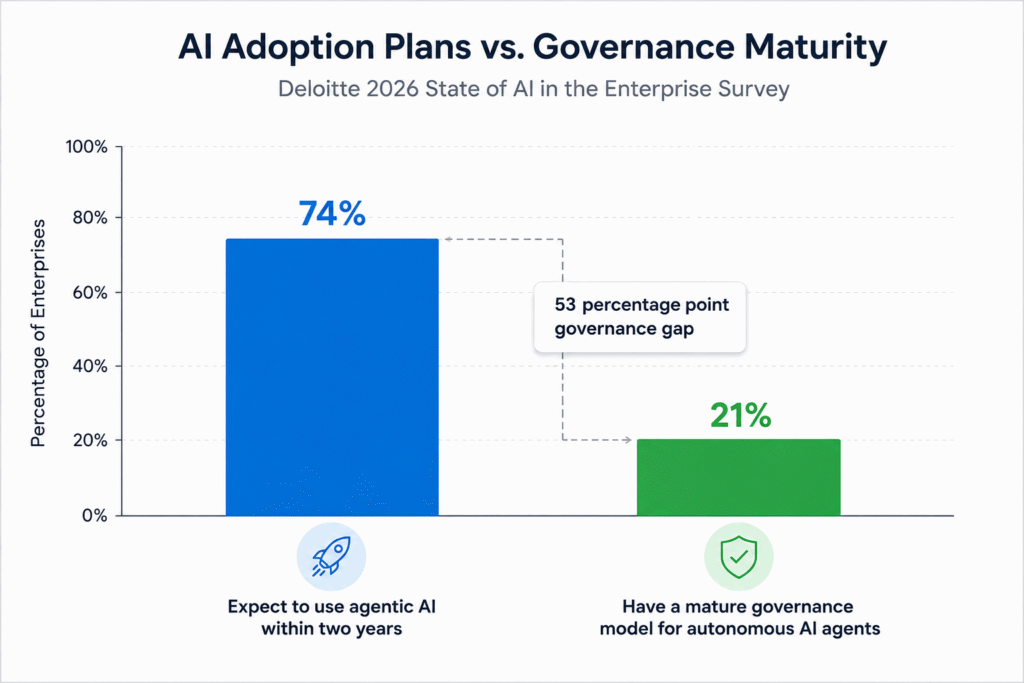
Nearly three-quarters of enterprises expect to use agentic AI within two years, according to Deloitte’s 2026 State of AI in the Enterprise survey of 3,235 leaders. Only 21% of those same organizations report having a mature governance model for it. That gap between adoption speed and oversight readiness is the core argument behind a claim gaining real traction in 2026: AI transformation is failing less because of the technology and more because of governance.
This guide breaks down the evidence behind that claim, what AI governance actually involves in practice, and where the argument has genuine limits.
Who this guide is for: business and IT leaders evaluating AI adoption, anyone researching AI governance frameworks, and readers trying to understand why so many AI initiatives underdeliver despite genuine investment.
Last verified: July 2026.
Quick Answer
AI transformation is widely described as a governance problem because the technology increasingly works, but organizations lack the ownership structures, data policies, and oversight needed to deploy it safely and effectively at scale. Deloitte, PwC, and MIT research all point to related patterns: adoption is outpacing the structures needed to manage it well.
Where Should You Focus First?
| If Your Problem Is… | Focus On… |
| Poor AI outputs | Model quality and task fit |
| Inconsistent AI decisions | Governance and process design |
| Regulatory risk | Compliance and audit trails |
| Sensitive data exposure | Data classification |
| Autonomous AI acting unpredictably | Human oversight checkpoints |
What “AI Governance” Actually Means
AI governance refers to the policies, ownership structures, and oversight mechanisms that determine what an AI system is allowed to do, what data it can access, who is accountable for its outputs, and how failures get caught and corrected. It’s distinct from AI ethics in the abstract sense, since governance is the operational infrastructure that makes ethical intentions actually enforceable inside a business.
The Evidence Behind the Governance Argument
Three separate data points, from three different research organizations, point toward a related set of conclusions.
- Deloitte (2026): 74% of surveyed enterprises expect to use agentic AI at least moderately within two years, but only 21% report having a mature governance model for autonomous AI agents.
- PwC (2026): the PwC 2026 AI Performance Study, surveying 1,217 senior executives across 25 sectors, found that 74% of AI’s economic value is captured by just 20% of organizations. PwC attributes the gap primarily to strategic orientation. Top-performing organizations use AI for growth and business reinvention rather than efficiency alone, with strong data and governance foundations cited as supporting factors rather than the sole explanation.
- MIT (2025): a widely cited study from MIT’s Project NANDA, titled “The GenAI Divide: State of AI in Business 2025”, found that 95% of generative AI pilots failed to deliver a measurable profit-and-loss impact. The report’s authors attributed this primarily to a “learning gap”, meaning poor integration into real workflows, rather than to weak model quality. That learning gap overlaps closely with governance, since unclear ownership and process design are part of why integration fails, though the study itself doesn’t use “governance” as its central framing.
Taken together, these findings suggest the bottleneck usually isn’t whether the AI models work. It’s whether organizations have built the structure, ownership, and integration processes needed to deploy them responsibly and consistently. It’s worth noting the MIT study’s methodology has also drawn some criticism for not fully accounting for indirect benefits like efficiency gains, so treat the 95% figure as directionally significant rather than a precise, uncontested number.
The “Blast Radius” Problem
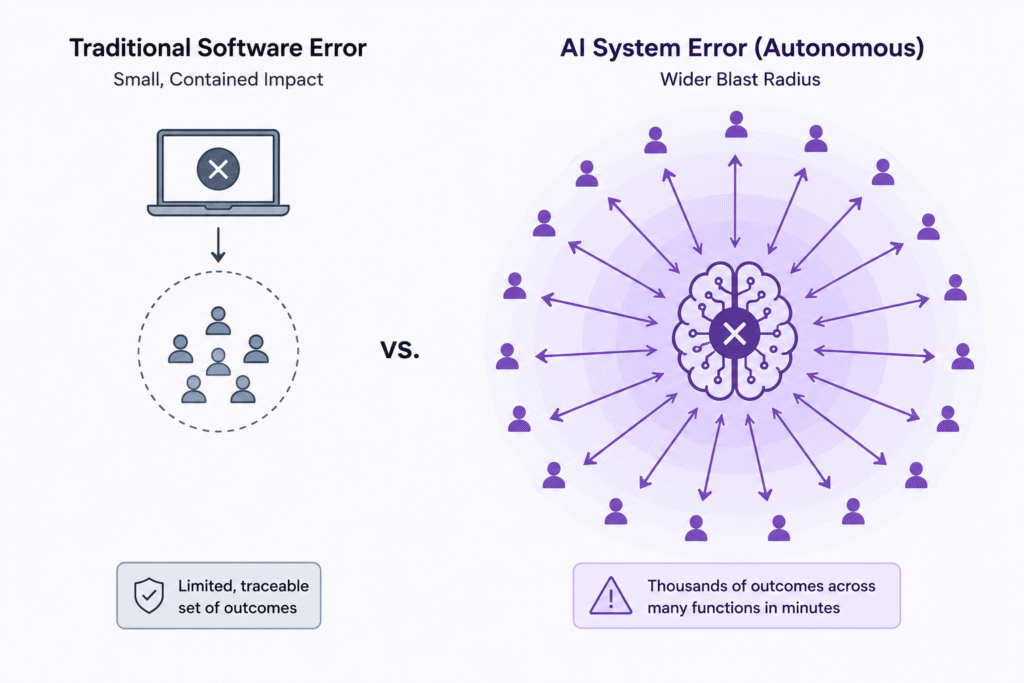
Researchers often explain governance’s importance using the idea of a wider “blast radius.” A flawed rule in a traditional system usually affects a limited, traceable set of outcomes. A flawed AI model making autonomous decisions can influence thousands of outcomes, hiring decisions, credit approvals, customer support responses, within minutes, often before anyone notices something is wrong. This wider blast radius is part of why governance gaps that were tolerable in older IT systems become genuinely risky once AI systems start acting with more autonomy.
Real-World Example
Consider a customer service AI agent deployed to answer policy questions automatically, without a human review step. If the underlying knowledge base contains an outdated policy, the agent can repeat that error consistently and immediately across every customer interaction, potentially thousands of conversations, before anyone notices the pattern. A comparable error made by a single human agent might affect a handful of customers before a supervisor caught it. That difference in scale and speed is what researchers describe as AI’s wider blast radius compared to traditional, human-driven processes.
Key Components of an AI Governance Framework
| Component | What It Covers |
| Clear ownership | Who is accountable for a specific AI system’s decisions and outcomes |
| Data classification | What data an AI system can access, and which data is off-limits |
| Audit trails | Logging every stage of an AI system’s decisions for later review |
| Human-in-the-loop checkpoints | Defined points where a human reviews or can override an AI decision |
| Regulatory mapping | Ensuring AI systems meet relevant rules, such as the EU AI Act, in each market they operate in |
| Shutdown capability | The ability to pause or disable an AI system quickly if it behaves unexpectedly |
Who should prioritize this most: organizations deploying agentic AI, systems that take autonomous action rather than simply generating content for a human to review, since the stakes and blast radius are meaningfully higher than with assistive AI tools.
AI Governance Maturity Stages
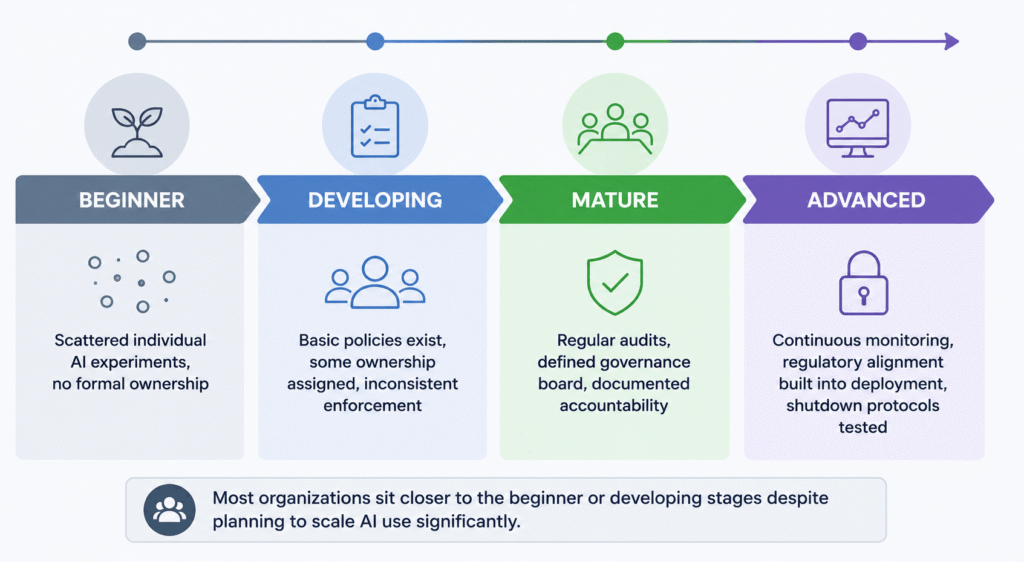
| Stage | Characteristics |
| Beginner | Scattered individual AI experiments, no formal ownership |
| Developing | Basic policies exist, some ownership assigned, inconsistent enforcement |
| Mature | Regular audits, defined governance board, documented accountability |
| Advanced | Continuous monitoring, regulatory alignment built into deployment, shutdown protocols tested |
Most organizations, based on Deloitte’s findings, sit closer to the beginner or developing stages despite planning to scale AI use significantly, which is the core mismatch this whole argument describes.
Common Governance Gaps
- No single owner for AI decisions: when accountability is diffuse across multiple teams, problems often go unnoticed until they’ve already caused damage.
- Treating governance as a one-time policy document: governance needs continuous monitoring and updates as AI systems and regulations change, not a document written once and shelved.
- No shutdown plan: some research suggests a meaningful share of organizations couldn’t actually disable a malfunctioning AI agent quickly if one emerged.
- Delegating governance entirely to technical teams: Deloitte’s research suggests organizations where senior leadership actively shapes AI governance see meaningfully better outcomes than those leaving it purely to technical staff.
- Ignoring cross-border data rules: multinational deployments often hit friction when data residency and regulatory requirements differ meaningfully by country.
How to Start Building AI Governance
- Assign clear ownership for each AI system in use, not just AI initiatives broadly.
- Classify your data before selecting an AI platform, so you know which use cases involve regulated or sensitive information.
- Build audit trails into every stage of the AI lifecycle, from data intake to model retirement.
- Define human-in-the-loop checkpoints for higher-stakes decisions, rather than assuming full automation is the goal everywhere.
- Start with lower-risk use cases and build governance maturity before scaling into higher-stakes, more autonomous deployments.
Is This Argument Overstated? A Balanced View
The governance argument is well-supported, but it isn’t the whole story. Some AI failures genuinely do stem from technical limitations, poor model selection, insufficient training data, or unrealistic expectations about what current AI can reliably do. Governance can’t fix a model that fundamentally isn’t suited to a task. The more accurate version of the claim is that governance and integration have become the more common and more expensive failure point relative to a few years ago, not that technology limitations have disappeared entirely. Developing the business acumen to tell these two failure modes apart matters as much as building governance structures themselves.
Frequently Asked Questions
Why is AI transformation considered a governance problem rather than a technology problem?
Research from Deloitte, PwC, and MIT all points to weak ownership, unclear accountability, and poor integration as more common causes of AI underperformance than the underlying AI models failing to work technically.
What is the “blast radius” problem in AI governance?
It describes how a single flawed AI system making autonomous decisions can affect a far larger number of outcomes, much faster, than a comparable failure in traditional software, making oversight gaps more costly than before.
What percentage of companies have mature AI governance?
According to Deloitte’s 2026 survey, only 21% of organizations report having a mature governance model for autonomous AI agents, despite 74% expecting to use agentic AI within two years.
Does good governance guarantee AI success?
No. Governance addresses ownership, oversight, and accountability, but it can’t fix a fundamentally unsuited AI model or unrealistic use case on its own. Both technical fit and governance matter.
What should a company do first when building AI governance?
Assigning clear ownership for each AI system and classifying what data it can access are generally the most practical starting points, before scaling into more autonomous or higher-stakes use cases.
Final Recommendation
If your organization is early in AI adoption, prioritize ownership and data classification before scaling further. If you’re already deploying agentic AI without a mature governance model, closing that gap should take priority over adding new AI capabilities. If you’re evaluating whether a specific AI failure was a technology issue or a governance issue, check whether the model itself was fundamentally suited to the task before assuming governance alone will fix it.
Conclusion
The evidence across multiple major research organizations points in a related direction: AI transformation increasingly succeeds or fails based on governance and integration, not raw model capability alone. That doesn’t mean technology no longer matters, but it does mean the organizations pulling ahead are the ones treating governance as core infrastructure, not an afterthought. Start with clear ownership and data classification, build oversight in from the start, and revisit your governance model as your AI use cases scale in autonomy. Organizations rarely fail because they adopted AI too slowly. They more often fail because they scaled AI faster than they scaled accountability.
Sources
- Deloitte, “State of AI in the Enterprise 2026” survey of 3,235 leaders
- MIT Project NANDA, “The GenAI Divide: State of AI in Business 2025”
- PwC, “2026 AI Performance Study”, survey of 1,217 senior executives across 25 sectors
- European Union AI Act, official regulatory framework documentation