
Business Acumen Definition: What It Means and Why It Matters

Two people can look at the same sales report and walk away with completely different conclusions. One sees a 10% revenue increase and celebrates. The other notices that cash flow is actually dropping and asks why. That second reaction is business acumen in action.
This guide covers the business acumen definition in plain terms, how it differs from related skills like financial literacy, and practical ways to build it, whether you’re an individual contributor or already leading a team.
Who this guide is for: employees preparing for leadership roles, managers who want sharper decision-making, and small business owners who want to understand their numbers beyond the surface level.
Last verified: July 2026.
Quick Definition
Business acumen is the ability to understand how a business operates, makes money, and competes and to use that understanding to make sound, well-reasoned decisions. It combines financial literacy, strategic thinking, and practical judgment, rather than being a single, isolated skill. The word “acumen” itself, you can see here for its full origin and definition, traces back to a Latin root meaning “sharp point,” a fitting image for the kind of sharp, practical thinking business acumen describes.
In simple terms: Business acumen means understanding how a business works and making decisions that improve its performance.
Business Acumen in One Sentence: Business acumen is the ability to understand how a business makes money and use that knowledge to make smarter decisions.
Why Business Acumen Matters
- Better decision-making: decisions grounded in how the business actually works tend to hold up better than ones based on gut feelings alone.
- Stronger promotion potential: employers consistently cite business acumen as a top factor when considering people for leadership roles.
- Clearer communication: understanding the business lets you frame your ideas in terms leadership already cares about, making them more persuasive.
- Better strategic thinking: connecting everyday decisions to broader business goals leads to more consistent long-term results. , not just the current quarter.
- Higher business profitability: stronger business acumen can help teams identify problems earlier and support better long-term financial decisions.
Key Business Acumen Skills and Why They Matter
| Skill | Why It Matters |
| Financial literacy | Lets you understand what’s actually in a financial report |
| Strategic thinking | Connects day-to-day decisions to long-term company goals |
| Situational judgment | Helps you read a business situation quickly and react appropriately |
| Communication and influence | Lets you explain financial or strategic reasoning in a way that moves people to act |
| Market awareness | Helps you understand competitors and stay ahead of industry shifts |
Business Acumen vs. Related Terms
It’s easy to confuse business acumen with a few adjacent skills, but the differences matter.
- Business acumen vs. financial literacy: financial literacy is understanding the numbers themselves. Business acumen is knowing what those numbers mean for decisions and being able to act on that understanding. You can have strong financial literacy without full business acumen, since acumen also depends on experience and judgement that formal training alone doesn’t fully provide.
- Business acumen vs. business intelligence: business intelligence usually refers to data tools and reporting systems. Business acumen is the human judgement applied to whatever data those tools produce.
- Business acumen vs. general intelligence: Someone can be highly intelligent without business acumen specifically, since acumen is domain-specific judgement built through business exposure, not a measure of overall smarts.
“Business acumen isn’t knowing every number. It’s knowing which numbers matter.”
How Business Acumen Builds, Step by Step
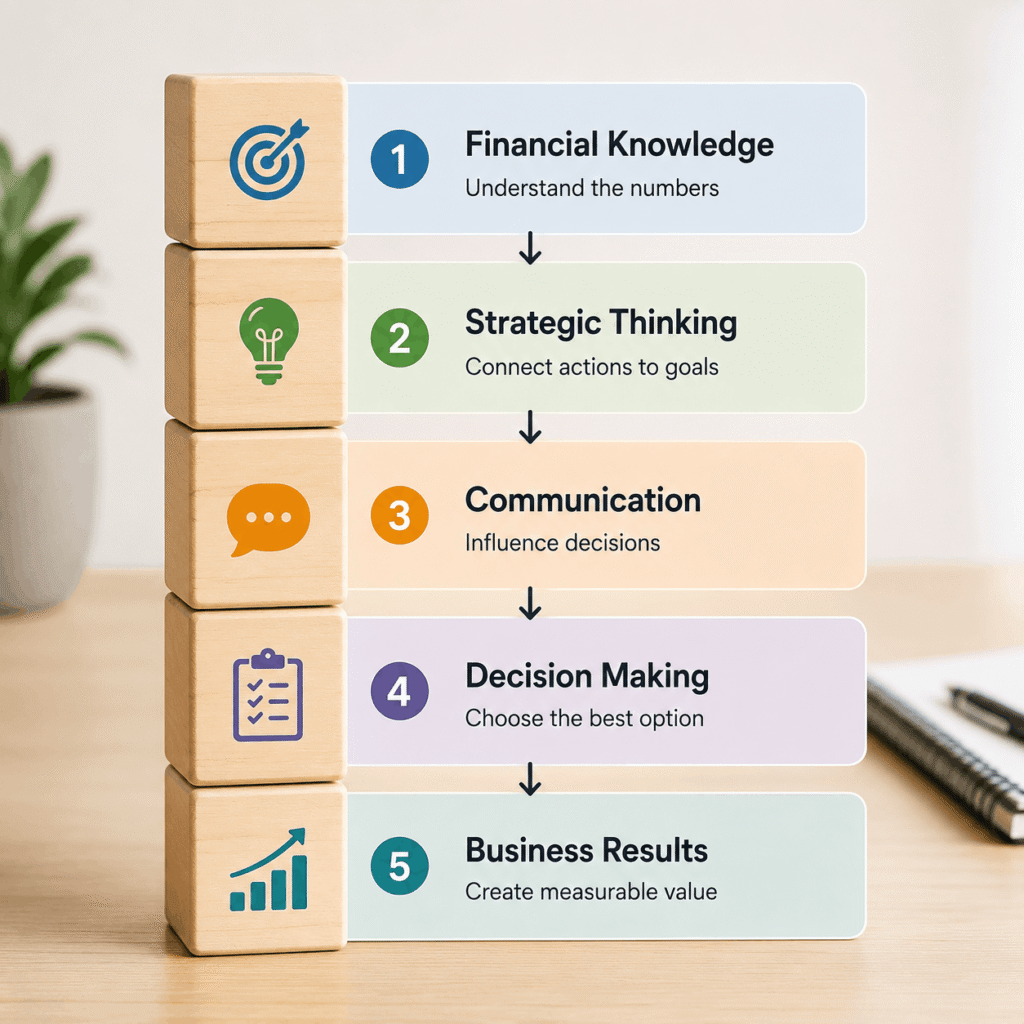
| Stage | Focus | Why It Matters |
| 1 | Financial Knowledge | Understand the numbers |
| 2 | Strategic Thinking | Connect actions to goals |
| 3 | Communication | Influence decisions |
| 4 | Decision Making | Choose the best option |
| 5 | Business Results | Create measurable value |
Each layer depends on the one before it. Financial knowledge without communication rarely influences anyone, and strategy without decision-making stays theoretical.
A Real-World Example
Consider an analyst at a retail company who notices sales are up 10% year over year, but free cash flow is falling. Without business acumen, the instinct is often to recommend cutting costs. With business acumen, the analyst digs deeper and finds the sales increase came from steep discounting in a new market, combined with extended payment terms for wholesale partners. The real issue isn’t spending; it’s a sales strategy that’s growing revenue at the expense of cash. That reframing, from “cut costs” to “revisit the sales strategy”, is what business acumen looks like in practice.
Business Acumen Examples by Profession
- Sales manager: noticing that a team is hitting revenue targets through heavy discounting, then adjusting the strategy before margins erode further.
- Marketing manager: tying a campaign’s success to actual revenue impact, not just engagement metrics, when reporting to leadership.
- HR manager: connecting hiring and retention decisions to their real cost impact on the business, not just filling open roles quickly.
- Software engineer: understanding why a feature matters to the company’s revenue or retention goals, not just building what’s requested without context.
- Small business owner: recognising that a busy sales month with slow-paying customers can create a cash crunch, even while revenue looks strong on paper.
Signs You Have Strong Business Acumen
- You instinctively ask how a decision affects revenue, cost, or cash flow, not just whether it “sounds good.”
- You can explain a financial result in plain language to someone outside your department.
- You notice when a metric’s improvement might be hiding a problem elsewhere, like the cash flow example above.
- You factor in competitors and market conditions, not just internal company data, when evaluating a decision.
- Colleagues and leadership regularly ask for your input on decisions outside your specific role.
How to Develop Business Acumen
Business acumen is generally considered a learned, experience-based skill rather than something people are simply born with, though some people build it faster due to natural curiosity about how things work.
- Learn how your specific business makes money: understand your company’s main products, target customers, and biggest cost drivers before trying to generalize to business in general.
- Read what leadership reads: investor communications, internal strategy updates, and planning documents reveal how leaders actually think about the business.
- Build basic financial modelling skills: understanding how revenue, costs, and cash flow connect makes abstract financial statements concrete.
- Seek cross-functional exposure: shadowing or working with departments outside your own builds the “big picture” view that acumen depends on.
- Find a mentor with strong business Judgement: a mentor can point out blind spots and provide feedback that formal training alone can’t replicate.
Who should be cautious here: Treating an MBA or certification alone as sufficient. Formal education helps with financial literacy specifically, but most researchers and practitioners in this field describe acumen as primarily behavioural and experiential, built through real decisions over time, not solely through coursework.
Business Acumen by Role
Business acumen looks somewhat different depending on where you sit in an organization.
- Individual contributors: connecting your specific tasks to the company’s broader goals and understanding how your work affects revenue or cost, even indirectly.
- Managers: translating company strategy into team-level decisions and explaining the “why” behind priorities to your team clearly.
- Executives and senior leaders: business acumen here extends to reading market trends, competitor moves, and long-term strategic positioning, not just internal operations.
If you’re currently exploring small business ideas rather than working inside an existing company, business acumen becomes especially valuable once you’re managing real financial decisions yourself, not just planning on paper.
Common Misconceptions About Business Acumen
- “You need an MBA to have business acumen.” Not necessarily. Formal education can help with financial literacy, but many people build strong acumen through direct experience and mentorship instead.
- “Business acumen is only for executives.” It’s genuinely useful at every level, since even individual contributors benefit from understanding how their work connects to broader business outcomes.
- “Business acumen means always focusing on the numbers.” Numbers matter, but acumen also depends on strategic thinking, communication, and market awareness working together, not financial literacy alone.
Common Mistakes That Signal Weak Business Acumen
- Confusing revenue with profit: a growing top line doesn’t guarantee a healthy business if costs are growing just as fast.
- Ignoring cash flow: a profitable business on paper can still run into trouble if cash isn’t coming in fast enough to cover expenses.
- Focusing only on short-term gains: decisions that boost this quarter’s numbers can sometimes damage long-term customer relationships or brand trust.
- Making decisions without customer data: internal assumptions about what customers want are no substitute for actually checking.
- Ignoring competitors: a decision that looks smart in isolation can look very different once you account for what competitors are doing.
Related Skills and Concepts
Business acumen overlaps with, but isn’t identical to, several related skills worth understanding on their own: financial literacy, strategic thinking, commercial awareness, critical thinking, leadership, and general decision-making. Strengthening any one of these tends to support the others.
Frequently Asked Questions
What is the simplest business acumen definition?
Business acumen is the ability to understand how a business works and to make sound decisions based on that understanding, combining financial literacy, strategic thinking, and practical judgement.
What is the difference between business acumen and financial literacy?
Financial literacy is understanding financial statements and metrics. Business acumen goes further, using that financial understanding to guide real decisions and connect numbers to strategy.
Can business acumen be learned, or is it innate?
Most research on the topic describes business acumen as a learned, experience-based skill, though people with natural curiosity about how things work often develop it faster.
Why do employers value business acumen so highly?
Employees with strong business acumen tend to make faster, better-aligned decisions, communicate more effectively with leadership, and require less oversight, which makes them stronger candidates for expanded responsibility.
How long does it take to build strong business acumen?
There’s no fixed timeline, since it depends on the person’s role and how much cross-functional exposure they get, but most people see meaningful improvement within one to two years of deliberate effort, such as mentorship and financial modelling practice.
Can business acumen be measured?
Not with a single test, but organizations commonly assess it indirectly through performance reviews, business simulations, case study exercises, and how well someone connects their decisions to measurable business outcomes over time.
How do companies assess business acumen in interviews or promotions?
Companies often use case-style interview questions, financial exercises, and leadership development programs to gauge business acumen, alongside simply observing how candidates or employees explain their past decisions and the reasoning behind them.
Final Recommendation
If you’re early in your career, focus first on understanding how your own company makes money and connecting your daily work to that bigger picture. If you’re already in a management role, prioritise cross-functional exposure and mentorship, since those tend to build judgement faster than additional coursework alone.
Conclusion
Business acumen is the ability to understand how a business operates and to turn that understanding into sound decisions, not just a formal credential or a single skill. Build it through real exposure to how your company makes money, deliberate financial modelling practice, and mentorship from people whose judgement you trust. The strongest business leaders aren’t the ones who memorise the most financial formulas. They’re the ones who consistently connect people, numbers, customers, and strategy to make better decisions.
Sources
- Merriam-Webster, dictionary definition and etymology
- Harvard Business Review, leadership and management research
- MIT Sloan Management Review, business strategy research
- U.S. Small Business Administration, small business planning guidance
- University career development resources on workplace skill-building