
Passive Income Ideas in 2026

Passive income is money earned with little ongoing daily effort, usually after an upfront investment of money, time, or both. It isn’t free money, and it isn’t usually as effortless as it sounds in a five-minute video. This guide breaks passive income ideas down honestly by budget, risk, and how much ongoing work they actually require. Building multiple income streams, sometimes called recurring or residual income, can add real financial stability over time.
Who this guide is for: people comparing their first passive income idea against a full-time job, investors weighing low-effort options against active ones, beginners with no money to start, and anyone tired of “passive income” content that quietly requires a part-time job’s worth of work. If you’re weighing this against starting your own venture instead, our guide to business ideas for women covers active alternatives worth comparing.
Last verified: July 2026.
This article is for general informational and educational purposes and is not financial advice. Consider your own risk tolerance, financial situation, and goals, and consult a licensed financial advisor before making investment decisions.
How We Chose These Ideas
Every idea here was evaluated against the same criteria, so the list stays consistent rather than random.
- How genuinely passive the ongoing effort is, not just the marketing description
- Realistic capital or time requirements, not a best-case scenario
- Real risk and downside, not just upside potential
- A mix of no-money, low-capital, and higher-capital options
- Tax implications, since passive income is still taxable income
Passive Income vs. Active Income
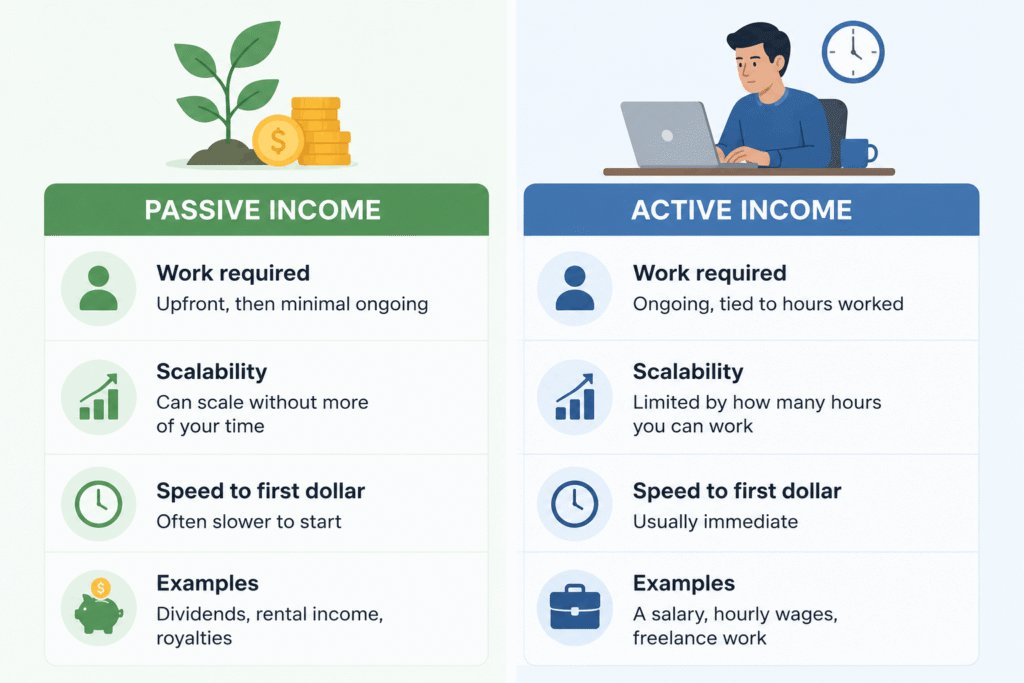
| Passive Income | Active Income | |
| Work required | Upfront, then minimal ongoing | Ongoing, tied to hours worked |
| Scalability | Can scale without more of your time | Limited by how many hours you can work |
| Speed to first dollar | Often slower to start | Usually immediate |
| Examples | Dividends, rental income, royalties | A salary, hourly wages, freelance work |
Passive Income Ideas by Budget
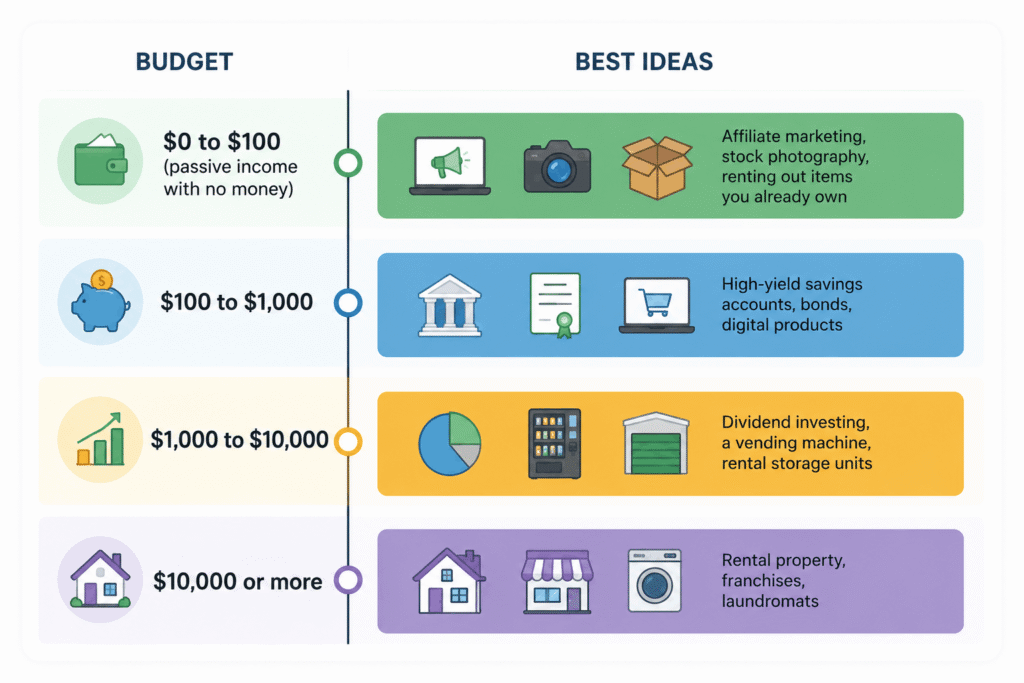
| Budget | Best Ideas |
| $0 to $100 (passive income with no money) | Affiliate marketing, stock photography, renting out items you already own |
| $100 to $1,000 | High-yield savings accounts, bonds, digital products |
| $1,000 to $10,000 | Dividend investing, a vending machine, rental storage units |
| $10,000 or more | Rental property, franchises, laundromats |
Best Passive Income Idea by Goal
| Goal | Best Choice |
| Lowest risk | High-yield savings account |
| Highest return potential | Rental property |
| Best for beginners | High-yield savings account |
| Best with no money | Affiliate marketing |
| Best long-term | Dividend investing |
| Most genuinely passive | Bonds |
Which Passive Income Idea Fits You?
- Have less than $500? Start with affiliate marketing or a digital product built around a skill you already have.
- Have $5,000 or more? Dividend investing or a vending machine both become realistic options. Our breakdown of a vending machine business covers real startup costs if that route interests you.
- Have $50,000 or more? Real estate becomes a genuinely realistic path, alongside continuing to build other income streams.
How Passive Is It, Really?
Not all “passive income” is equally passive, and being honest about this upfront saves a lot of frustration later.
- Genuinely passive after setup: high-yield savings accounts, dividend stocks, and bonds require almost no ongoing effort once you’ve made the initial investment.
- Semi-passive: rental real estate and renting out items you own require occasional management, even if it’s less than a full-time job.
- Effort-heavy at first, more passive later: digital products, online courses, and stock photography require real upfront work, and continued marketing effort often still helps, despite being sold as “set it and forget it”.
- Not really passive: content creation, such as YouTube channels or blogs, generally requires ongoing, ideally consistent output to sustain income, closer to a part-time job than passive income.
Quick Comparison: Passive Income Ideas at a Glance
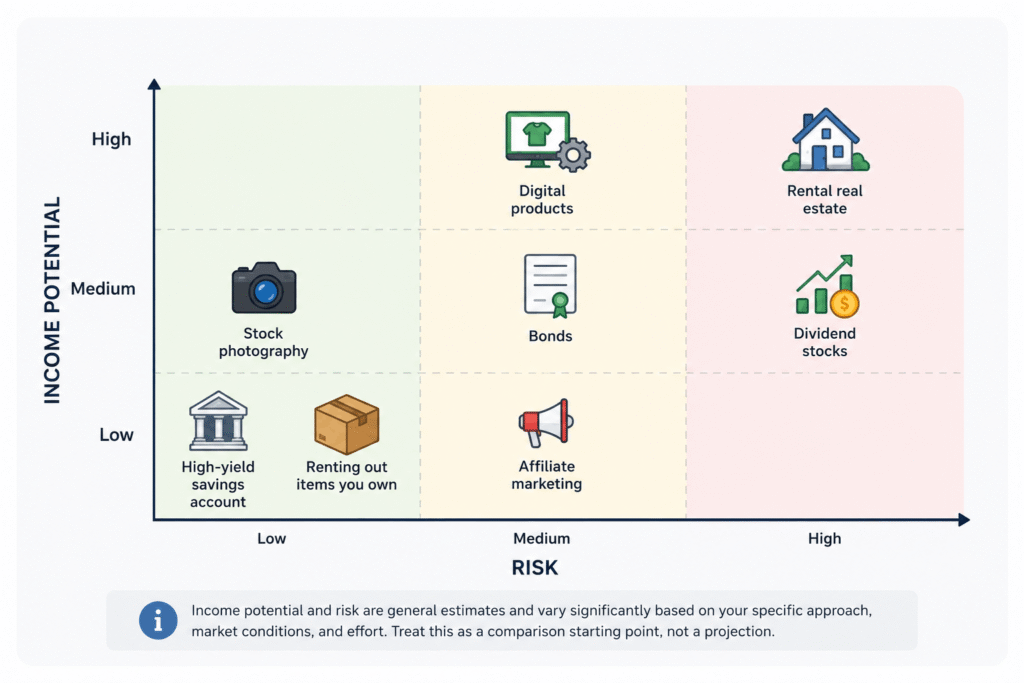
| Idea | Startup Cost | Income Potential | Risk | Ongoing Effort |
| High-yield savings account | Low | Low | Very low | Very low |
| Dividend stocks | Medium to high | Medium | Medium | Low |
| Bonds | Medium to high | Low to medium | Low to medium | Very low |
| Rental real estate | High | Medium to high | Medium to high | Medium |
| Digital products | Low | Low to high | Low | Low once launched |
| Renting out items you own | Low | Low to medium | Low to medium | Medium |
| Stock photography | Low | Low | Low | Low |
| Affiliate marketing | Low | Low to medium | Low | Medium, ongoing |
Income potential and risk are general estimates and vary significantly based on your specific approach, market conditions, and effort. Treat this as a comparison starting point, not a projection.
Time to Profit
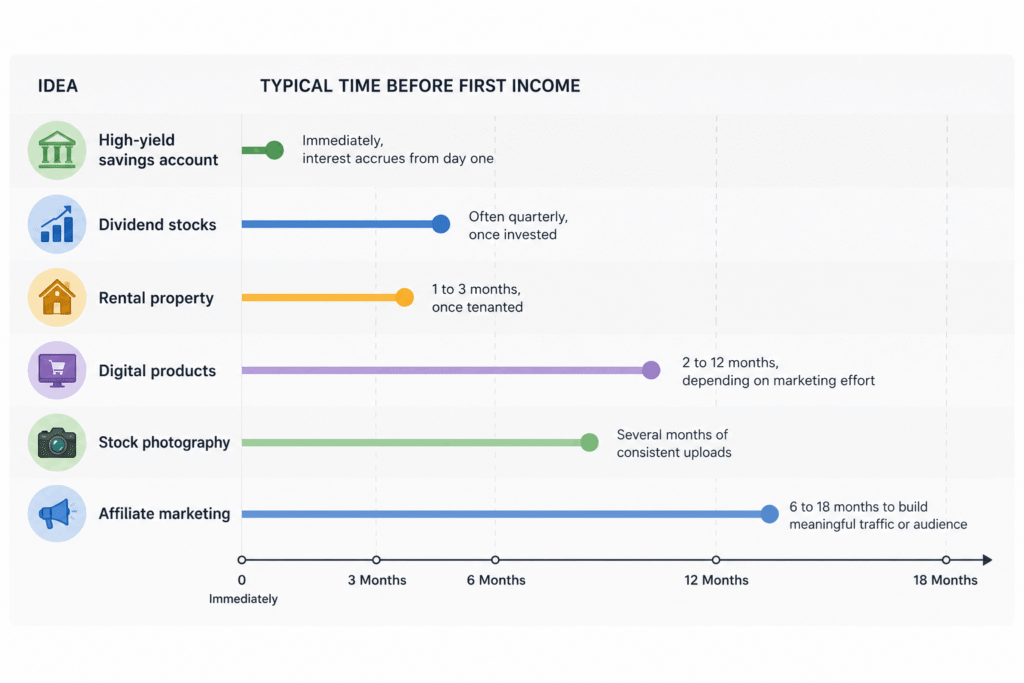
| Idea | Typical Time Before First Income |
| High-yield savings account | Immediately, interest accrues from day one |
| Dividend stocks | Often quarterly, once invested |
| Rental property | 1 to 3 months, once tenanted |
| Digital products | 2 to 12 months, depending on marketing effort |
| Stock photography | Several months of consistent uploads |
| Affiliate marketing | 6 to 18 months to build meaningful traffic or audience |
How Much Passive Income Can You Realistically Make?
Ranges here are intentionally wide, since actual results depend heavily on capital, effort, and market conditions. Treat these as general context, not as a promise.
- High-yield savings account: often a few hundred to a couple thousand dollars a year, depending on your balance and current interest rates.
- Dividend portfolio: varies enormously by amount invested, but a meaningful portfolio might generate low hundreds to several thousand dollars annually.
- Rental property: can range from a few hundred dollars a month in profit to significantly more, depending on the property, location, and financing.
- Affiliate marketing or digital products: highly variable, from effectively nothing in the early months to a meaningful side income once an audience or customer base is established.
No one can honestly promise a specific income because results depend on your capital, market conditions, and ongoing effort.
Pros and Cons of Passive Income
| Pros | Cons |
| Extra income beyond your main job | Often requires real upfront work or capital |
| Can scale without proportionally more time | Still subject to taxes |
| Adds flexibility to your finances | Carries real risk, depending on the idea |
| Can diversify your overall income sources | Rarely as immediate as marketing suggests |
Investment-Based Passive Income Ideas
These require capital upfront but generally the least ongoing effort of any category.
High-Yield Savings Accounts
Best for: beginners wanting a low-risk, low-effort starting point, including beginners with very little money to invest.
Capital needed: as little as you’re comfortable depositing, since most accounts have no or low minimums.
Why it works: these accounts pay meaningfully higher interest than a standard savings account, and funds generally stay accessible if you need them.
Who should skip this: anyone hoping for significant returns, since HYSAs are designed for safety and liquidity, not high growth.
Practical tip: rates vary between banks and change over time, so comparing current rates before depositing a large sum is worth the extra few minutes.
Dividend Stocks
Best for: long-term investors comfortable with stock market risk.
Capital needed: varies widely, though fractional shares now let you start with relatively small amounts.
Why it works: dividend-paying companies distribute a portion of profits to shareholders regularly, typically quarterly, and reinvesting those dividends can compound growth over time. Reinvesting dividends and interest allows returns to compound over time, which is one of the biggest advantages of long-term passive investing.
Who should skip this: anyone uncomfortable with market volatility, since stock values, including dividend payers, can decline.
Practical tip: you can check here for general investor education resources from the SEC before choosing individual stocks, since understanding the basics of risk and diversification matters more than chasing any single stock’s dividend yield.
Bonds
Best for: more conservative investors prioritizing steady, predictable income over growth.
Capital needed: varies by bond type, with government bonds generally accessible at lower amounts than many corporate bonds.
Why it works: bonds pay regular interest and are generally considered lower risk than stocks, though returns tend to be more modest.
Who should skip this: investors specifically seeking high growth, since bonds are built for stability rather than significant appreciation.
Practical tip: bond values can still fluctuate with interest rate changes, so they aren’t entirely risk-free despite the “safe” reputation.
Real Estate and Asset-Based Passive Income
These require more capital and more ongoing involvement than pure investment options but can offer strong long-term returns.
Rental Real Estate
Best for: investors with enough capital for a down payment and the bandwidth to manage a property directly or through a property manager.
Capital needed: high, including a down payment, closing costs, and a reserve for repairs and vacancies.
Why it works: tenants pay rent that ideally covers your mortgage and expenses, with the remainder as profit, and rental income can also serve as an inflation hedge since rents often rise with the cost of living.
Who should skip this: anyone without the time or willingness to handle tenant issues, maintenance, or hiring a property manager to do it for them.
Practical tip: the IRS treats rental income as taxable, though expenses like depreciation and repairs can offset some of that tax burden, so working with a tax professional familiar with real estate is worth the cost.
Renting Out Items You Already Own
Best for: anyone with underused assets, like a car, parking space, or storage area, including those looking for passive income with no money down.
Capital needed: typically low to none, since you’re monetizing something you already own.
Why it works: platforms built for peer-to-peer rentals make it easier to list and manage bookings without building your own system from scratch.
Who should skip this: anyone uncomfortable with strangers using their property or without insurance coverage appropriate for rental use.
Practical tip: confirm your existing insurance covers rental use before listing anything, since standard personal insurance policies often exclude business use.
Digital Products and Content-Based Passive Income
These require real upfront effort and often some ongoing marketing but can scale well once established.
Digital Products (Courses, Templates, E-books)
Best for: people with existing expertise or a skill they can package into a repeatable product.
Capital needed: generally low, though your time investment upfront is significant.
Why it works: once created, a digital product can sell repeatedly with little added production cost per sale.
Who should skip this: anyone expecting fast results, since building an audience and refining a product that actually sells usually takes sustained effort over months.
Practical tip: picking a narrow, specific topic tends to perform better than a broad, generic one, since it’s easier to market to a clearly defined audience.
Stock Photography and Video
Best for: people with photography or videography skills and a library of existing content.
Capital needed: low, mainly equipment you may already own.
Why it works: stock platforms pay ongoing royalties each time your content is licensed, and a large enough library can generate a steady trickle of income.
Who should skip this: anyone expecting significant income quickly, since per-license payouts are typically small and require volume to add up.
Practical tip: Focusing on evergreen, widely applicable themes tends to generate more licences over time than narrowly trendy content.
Affiliate Marketing
Best for: creators or content owners with an existing, engaged audience.
Capital needed: low financial cost, but it takes real time to build a following worth monetizing.
Why it works: you earn a commission when your audience purchases a product through your referral link without needing to create or ship anything yourself.
Who should skip this: anyone without an existing audience or platform, since affiliate income depends heavily on genuine reach and trust.
Practical tip: Partnering only with products you’d genuinely recommend tends to build more long-term trust and income than promoting anything for a commission.
Tax Considerations for Passive Income
Passive income is still taxable income in the eyes of the IRS, regardless of how little effort it required. You can check here for official IRS guidance on reporting different income types, including the specific rules on passive activities outlined in IRS Publication 925, since rental income, dividends, and interest are each reported differently. Rental income, for example, can often be offset by depreciation and repair costs, while dividend income may be taxed at a different rate depending on whether it’s qualified or ordinary. Working with a tax professional familiar with your specific income types is generally worth the cost once you have more than one passive income stream running. Understanding your own numbers, not just handing them to an accountant blindly, is part of the business judgement that separates people who grow their income streams from people who stay stuck at one.
A Word on Higher-Risk Options Like Crypto
Cryptocurrency can generate passive income through staking or yield products, but it also carries significantly higher risk than traditional investments like savings accounts or dividend stocks. If you’re interested in crypto specifically, treat it as a speculative allocation you could afford to lose, not a core passive income strategy, and review current guidance from FINRA and the SEC before investing any meaningful amount.
Things to Avoid
- MLMs marketed as passive income: most multi-level marketing schemes require constant recruiting and selling and rarely resemble genuine passive income.
- Unrealistic guaranteed returns: any investment promising a fixed, high, guaranteed return should be treated with serious scepticism.
- Unregulated investment schemes: stick to platforms and products regulated by recognized bodies like the SEC or FINRA.
- Courses promising overnight wealth: building any of the ideas in this guide takes months of real effort, not a weekend.
Common Passive Income Mistakes
- Believing ‘passive’ means ‘no work’: most ideas on this list require real upfront effort, even the ones marketed as fully hands-off.
- Chasing high returns without understanding the risk: higher potential income almost always comes with higher potential loss.
- Investing money you may need soon: locking up funds you might need for an emergency defeats the purpose of building financial security.
- Ignoring taxes: passive income is still taxable, and failing to plan for that can create an unpleasant surprise at filing time.
- Failing to diversify: relying on a single passive income source concentrates your risk more than spreading across a few different ideas, and pairing passive income with an active small business idea is another common way people diversify.
- Expecting immediate income: most ideas here take months, not days, to produce meaningful returns.
Frequently Asked Questions
What is the most realistic passive income idea for beginners?
High-yield savings accounts are generally the most realistic starting point, since they require minimal capital, carry low risk, and need almost no ongoing effort.
Is passive income actually taxable?
Yes. The IRS treats passive income, including rental income, dividends, and interest, as taxable, even though it required little ongoing effort to earn.
How much money do I need to start earning passive income?
It depends heavily on the idea. High-yield savings accounts and digital products can start with very little capital, while rental real estate typically requires a substantial down payment.
Which passive income ideas require no money?
Renting out items you already own and affiliate marketing (if you already have an audience) are among the few ideas that can start with little to no upfront capital, though both still require real-time investment.
Which passive income ideas are best for students?
Stock photography, digital products built around a specific skill, and affiliate marketing tend to fit well around a student schedule, since they don’t require significant capital or a fixed daily time commitment.
Can passive income replace a salary?
For some people, eventually, yes, but this typically requires significant capital or years of compounding effort, not a quick replacement for active income in most cases.
Is a YouTube channel or blog really passive income?
Not entirely. Both usually require consistent, ongoing content creation to sustain income, which makes them closer to a part-time job than fully passive income, at least in the early years.
What is the safest passive income idea?
High-yield savings accounts and bonds are generally considered lower-risk than stocks, real estate, or cryptocurrency, though “safest” still depends on your specific goals and time horizon.
Final Recommendation
If you’re just starting out with limited capital, a high-yield savings account is the lowest-risk entry point while you build up funds for other options. If you have a specific skill to package, a digital product offers strong long-term scalability for a relatively low upfront cost. If you have significant capital and are willing to manage a property, rental real estate offers some of the strongest long-term wealth-building potential on this list, alongside its higher effort and risk.
Conclusion
The best passive income idea depends on how much capital you have, how much ongoing effort you’re genuinely willing to put in, and how much risk you can tolerate. Compare your situation honestly against the categories above, since the ideas marketed as most “passive” aren’t always the ones that actually are. Building a mix of passive income streams, rather than relying on just one, tends to create more stable long-term financial security.
Sources
- Internal Revenue Service (IRS), guidance on reporting passive income and Publication 925 on passive activity rules
- U.S. Securities and Exchange Commission (SEC), Investor.gov educational resources
- Financial Industry Regulatory Authority (FINRA), investor education resources
- Consumer Financial Protection Bureau (CFPB), consumer finance guidance
- Federal Reserve, data on interest rates and savings account yields
- Industry data on digital product, stock photography, and affiliate marketing platforms