
Business Ideas for Women in 2026

Women now own more than 14 million businesses in the US, generating an estimated $3.3 trillion in annual revenue. That growth is real, but so is the funding gap many women entrepreneurs still face, estimated at $1.7 trillion globally. Knowing which business idea fits your situation and which funding resources actually exist matters as much as the idea itself.
This guide covers business ideas for women organized by startup cost and business model, along with funding resources built specifically for women founders, so you’re not starting from a generic list.
Who this guide is for: women exploring a first business, side hustlers testing an idea before going full-time, and stay-at-home parents looking for flexible, home-based income.
Last verified: July 2026. Market demand, startup costs, and funding programs change over time, so confirm current details before committing.
Quick Fact: Women own more than 14 million businesses in the U.S., employing millions of people and generating trillions in annual revenue.
Women-Owned Businesses by the Numbers
- More than 14 million women-owned businesses currently operate in the U.S.
- These businesses generate an estimated $3.3 trillion in annual revenue.
- Collectively, they employ millions of people nationwide.
- Women continue to start new businesses faster than many other demographic groups, even as a real financing gap persists.
How We Chose These Business Ideas
Every idea here was evaluated against the same criteria, so the list stays consistent rather than random.
- Real, current market demand rather than a fading trend
- A realistic startup cost range, not just a best-case estimate
- Flexibility to run part-time, full-time, or entirely from home
- A mix of digital, service-based, and creative business types
- Genuine scalability potential beyond a single-person side income
Quick Comparison: Business Ideas for Women at a Glance
| Business Idea | Startup Cost | Time to Launch | Best For | Flexibility |
| Virtual assistant services | Under $500 | About 1 week | Fast, low-cost entry | Fully remote |
| Social media management | $2,000 to $8,000 | 2 to 4 weeks | Marketing-minded founders | Fully remote |
| Copywriting and content services | Under $500 | About 1 week | Strong writers | Fully remote |
| Health and wellness coaching | $1,000 to $5,000 | 4 to 8 weeks | Certified coaches | Remote or in-person |
| Etsy or handmade goods shop | Under $500 | 1 to 2 weeks | Creative, hands-on founders | Home-based |
| Bookkeeping services | Under $1,000 | 2 to 4 weeks | Detail-oriented founders | Fully remote |
| Cleaning services | $500 to $2,000 | 1 to 2 weeks | Hands-on, local work | Local, in-person |
| Photography | $2,000 to $8,000 | 2 to 4 weeks | Photography skills | Local, in-person |
| Online courses | $2,000 to $10,000 | 6 to 10 weeks | Subject-matter experts | Fully remote |
| Tutoring | Under $500 | About 1 week | Subject-matter experts | Remote or in-person |
Startup costs are general estimates that vary by scale and location, so treat these as planning ranges rather than fixed figures.
Business Ideas for Women by Category
- Best low-cost idea to start this week: Virtual assistant services
- Best for a creative, hands-on business: Etsy or handmade goods shops
- Best for flexible, remote work: Bookkeeping or copywriting
- Best for turning existing expertise into income: Health and wellness coaching or online courses
- Best for local, community-based work: Cleaning services or photography
Best Business Idea by Goal
| Goal | Best Business |
| Lowest startup cost | Virtual assistant services |
| Highest long-term income potential | Online courses |
| Fastest to launch | Copywriting |
| Most flexible schedule | Bookkeeping |
| Best for creatives | Etsy or handmade goods shop |
| Best recurring income | Bookkeeping |
How to Choose the Right Business Idea
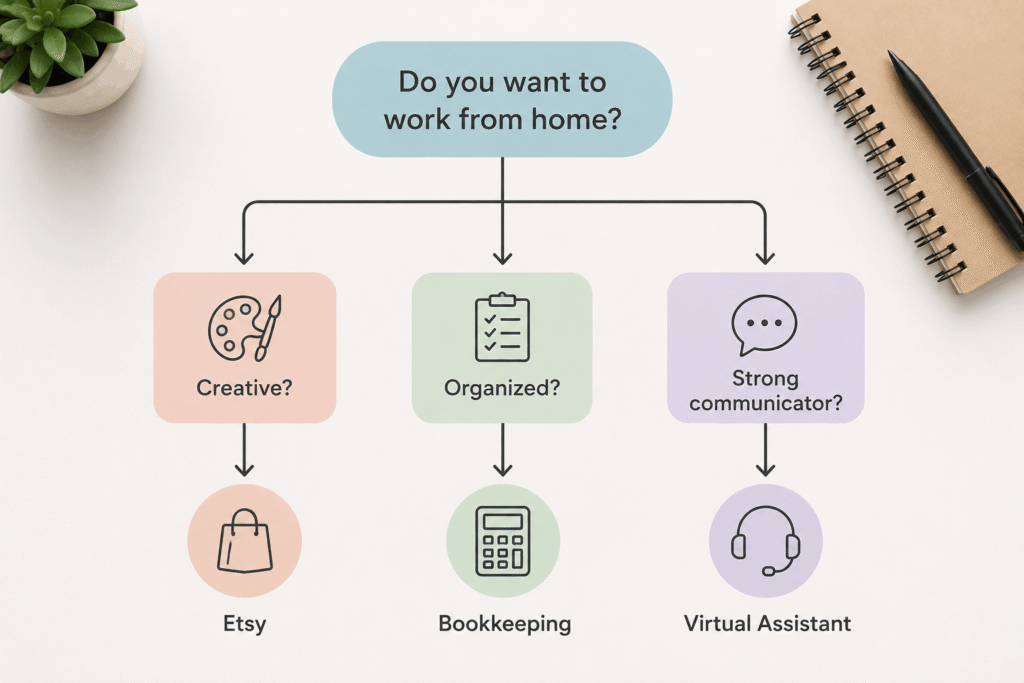
Before picking from the list below, ask yourself a few honest questions.
- How much time do you actually have? A side hustle run in the evenings needs a different business type than one you’re launching full-time.
- Do you want fully remote work, or are you comfortable working locally in person? This narrows the list significantly on its own.
- Do you enjoy sales and client conversations, or would you rather avoid them? Some ideas, like coaching, depend heavily on this; others, like bookkeeping, less so.
- What’s your realistic budget? Some ideas need under $500, while others require $5,000 or more before your first sale.
- Do you need flexible hours, such as around childcare or another job? Fully remote, client-based work tends to offer more scheduling control than local, appointment-based services.
- What skills do you already have? Businesses built on existing skills launch faster and carry less risk than ones requiring a new certification first. As your business grows, developing stronger business judgement and financial understanding becomes just as important as the initial idea itself.
If You Are… Which Business to Consider
| If you’re… | Consider |
| Creative | Etsy or handmade goods shop |
| Organized and detail-oriented | Bookkeeping |
| A strong communicator | Virtual assistant services |
| Into social media and trends | Social media management |
| A natural teacher | Tutoring |
| Passionate about wellness | Health and wellness coaching |
Most Profitable Business Ideas for Women
Profitability depends heavily on execution, but a few ideas on this list consistently show stronger income potential than others.
- Online courses: once built, a course can sell repeatedly with little added production cost, giving it some of the strongest long-term income potential on this list.
- Bookkeeping: recurring monthly clients and relatively low overhead support solid, stable margins.
- Copywriting, run as an agency: subcontracting additional writers once you have steady client demand can multiply income beyond what one person can bill alone.
- Photography, positioned for weddings or businesses: higher price points per booking can offset the more seasonal, less recurring nature of the work.
- Health and wellness coaching: group programs or digital courses built from a proven one-on-one framework can scale income beyond hourly client work.
Profitability and Scalability Comparison
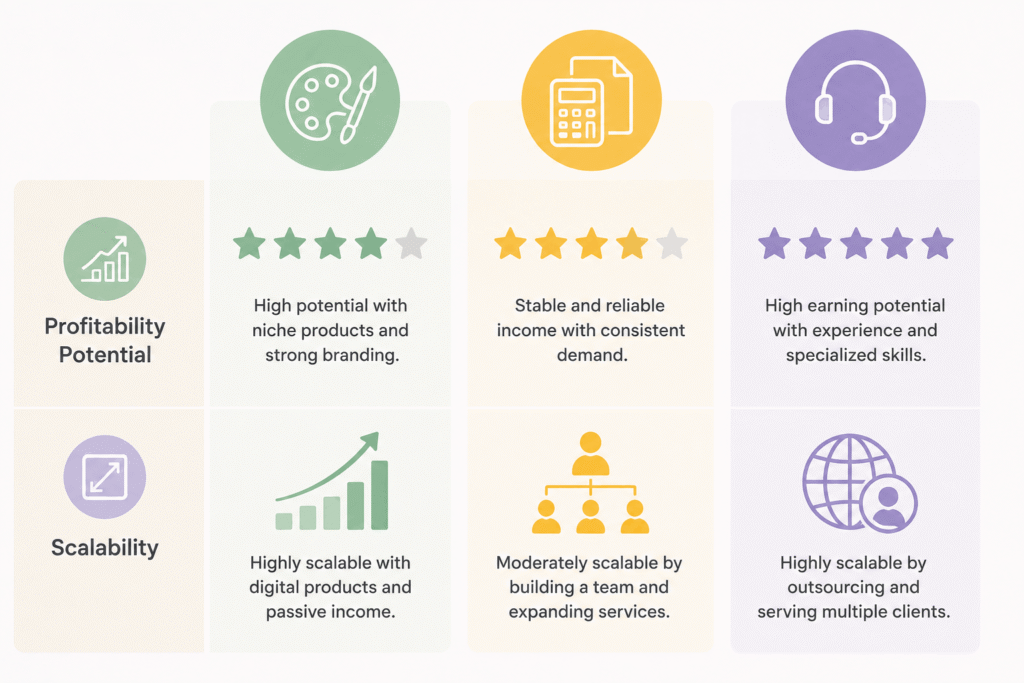
| Business | Income Potential | Difficulty | Scalability |
| Virtual assistant | $$ | Easy | Medium |
| Social media management | $$$ | Medium | High |
| Copywriting | $$$ | Medium | High |
| Bookkeeping | $$$ | Medium | High |
| Etsy shop | $$ to $$$ | Medium | High |
| Health and wellness coaching | $$$ | Medium | High |
| Online courses | $$ to $$$$ | Hard | Very High |
| Photography | $$ to $$$ | Medium | Medium |
| Cleaning services | $$ | Easy | Medium |
| Tutoring | $$ | Easy | Medium |
Income potential varies by experience, location, pricing strategy, and client demand, so treat these figures as general context rather than a guarantee.
Funding and Resources Built for Women Entrepreneurs
The financing gap women face is real, but a few resources specifically target it, and most competitor guides skip over them entirely.
- SBA Office of Women’s Business Ownership: you can check here for current grant and lending programs, including a nationwide network of Women’s Business Centers offering free or low-cost mentoring.
- Amber Grant: a monthly grant program awarding funding to women-owned businesses, with no repayment required for winners.
- National Association of Women Business Owners (NAWBO): a membership organization offering networking, mentorship, and advocacy specifically for women founders.
Many local governments, nonprofit organizations, and state economic development agencies also offer grants and low-interest loans specifically for women-owned businesses, so it’s worth checking what’s available in your specific state or city beyond the national programs above. Grant eligibility, deadlines, and funding amounts change regularly, so always verify the latest requirements on the official program website before applying.
Do you need a licence?
A few ideas on this list carry specific licensing or certification considerations, and requirements vary meaningfully by state or country.
- Health and wellness coaching: certain health-related claims can cross into regulated territory depending on your state and specific niche.
- Bookkeeping: generally unregulated at a basic level, though offering tax advice specifically may require additional credentials.
- Cleaning services: generally low regulatory burden, though bonding and insurance are strongly recommended even where not legally required.
- Photography: minimal licensing in most areas, though a local business licence may still be required depending on your city.
- Tutoring: generally unregulated for independent tutors, though tutoring centres or specific subjects may have additional requirements in some states.
Confirm current requirements for your specific location and business type before launching, since rules do change.
Best Business Ideas for Women
Virtual Assistant Services
Best for: anyone wanting the fastest, lowest-cost entry into self-employment.
Startup cost: generally under $500, since the main requirement is a laptop and reliable internet.
Why it works: small businesses increasingly outsource scheduling, email management, and customer support rather than hiring a full-time employee, and the role suits women balancing other responsibilities since hours are flexible.
Who should skip this: anyone uncomfortable with ongoing client communication, since the role is relationship-heavy by nature.
Practical tip: starting with one or two long-term clients tends to build more stable income than chasing many one-off gigs early on. Learning AI productivity tools can help automate repetitive tasks, allowing you to serve more clients without increasing your working hours.
Social Media Management
Best for: marketing-minded founders comfortable managing multiple client accounts.
Startup cost: generally $2,000 to $8,000 for tools, branding, and initial outreach.
Market demand: local businesses increasingly depend on consistent content across platforms like Instagram and TikTok, but few have the in-house time to manage it well.
Who should skip this: founders who dislike consistent client reporting, since retention depends heavily on demonstrating results.
Practical tip: targeting local boutiques, gyms, or wellness studios as a starting niche tends to produce steadier referral growth than serving unrelated industries.
Copywriting and Content Services
Best for: strong writers who want a low-overhead freelance business.
Startup cost: generally under $500, mainly a portfolio and outreach time.
Why it works: small companies consistently need website copy, email sequences, and blog content, and this business fits easily around a variable schedule.
Who should skip this: anyone who dislikes revision-heavy client work, since copywriting often involves multiple rounds of feedback.
Practical tip: building a small portfolio of sample work before your first paid client makes outreach noticeably easier than starting with nothing to show.
Health and Wellness Coaching
Best for: certified coaches wanting to turn expertise into a client-based business.
Startup cost: generally $1,000 to $5,000 for certification and basic marketing, if not already certified.
Why it works: consumer spending on wellness, nutrition, and lifestyle coaching has grown significantly, with strong demand for coaches who understand clients’ real-life constraints.
Who should skip this: anyone without a certification relevant to their specific coaching niche, since credibility matters heavily in this space.
Practical tip: offering both in-person and online sessions from the start widens your potential client base without much added cost.
Etsy or Handmade Goods Shop
Best for: creative founders wanting to sell physical or digital products.
Startup cost: generally under $500 to start, mainly materials and listing fees.
Why it works: platforms like Etsy have built-in customer traffic, and roughly 80% of Etsy sellers are women, making it one of the more established paths for creative small businesses.
Who should skip this: anyone expecting fast, large-scale income, since building a steady customer base on marketplace platforms usually takes sustained effort over months, not weeks.
Practical tip: starting with a narrow product niche, rather than a broad, generic shop, tends to perform better against more established competitors on the same platform.
Bookkeeping Services
Best for: detail-orientated founders comfortable with financial software.
Startup cost: generally under $1,000 for software and certification if needed.
Income potential: small businesses consistently need help managing daily transactions and basic financial reporting, often at a fraction of the cost of a full-time hire.
Who should skip this: anyone uncomfortable with detail-heavy, deadline-driven work, since errors here directly affect a client’s finances.
Practical tip: Specialising in one industry, such as e-commerce or wellness businesses, makes your services easier to market than staying fully generalist.
Cleaning Services
Best for: founders who want hands-on, local work with straightforward pricing.
Startup cost: typically $500 to $2,000 for basic supplies and initial marketing.
Why it works: demand spans office cleaning, residential homes, and Airbnb turnovers, each with fairly predictable, recurring scheduling.
Who should skip this: anyone not prepared for physically demanding, recurring work, since consistency matters more than any single job.
Practical tip: focusing on a specific niche, like Airbnb turnover cleaning, tends to be more profitable than taking any client anywhere in a city.
Photography
Best for: founders with photography skills wanting event or portrait-based work.
Startup cost: typically $2,000 to $8,000 for camera equipment.
Why it works: weddings, family portraits, and small business content needs provide steady, if seasonal, demand.
Who should skip this: anyone without existing photography skills, since equipment alone doesn’t produce a marketable portfolio.
Practical tip: building a small business content package for local companies can help smooth out the seasonality of wedding and event work.
Online Courses and Digital Education
Best for: subject-matter experts wanting to turn existing knowledge into a scalable product.
Startup cost: typically $2,000 to $10,000 for course production and platform costs.
Growth opportunity: the online education market has grown substantially, and a well-made course can generate income long after the initial time investment.
Who should skip this: anyone without a genuinely differentiated angle, since course marketplaces are increasingly crowded in popular topics.
Practical tip: picking a specific, narrower niche rather than a broad, generic topic tends to perform better against more established competitors.
Tutoring
Best for: subject matter experts wanting flexible, part-time, or full-time work.
Startup cost: generally under $500.
Why it works: Demand spans K-12 academic subjects, test prep, and adult skills tutoring and can be delivered online or in person, making it easy to fit around a family schedule.
Who should skip this: anyone without patience for repetitive explanation, since tutoring is inherently instructional rather than project-based.
Practical tip: specialising in a specific test or subject, rather than general tutoring, tends to command higher rates.
Small Business Ideas for Women at Home
Several ideas on this list work especially well run entirely from home, without needing a separate commercial space or major upfront investment.
- Virtual assistant services and copywriting both require only a laptop and internet connection.
- Bookkeeping and online courses can be produced and managed entirely from a home setup once initial systems are in place.
- Etsy shops are one of the most established home-based paths, since inventory and packaging can be managed from a spare room or kitchen table.
- Tutoring, delivered online, requires no commercial space at all beyond a quiet room and a stable internet connection.
If you want a broader view of business ideas beyond ones specifically framed for women, our guide to small business ideas covers 20 options across a wider range of startup costs and industries.
Frequently Asked Questions
What are the best business ideas for women to start?
Virtual assistant services, social media management, and Etsy shops are consistently strong picks, since they combine real demand with relatively low startup costs and flexible schedules.
What are good small business ideas for women to run from home?
Virtual assistant work, bookkeeping, copywriting, and Etsy shops all work well entirely from home, requiring little more than a laptop or a small dedicated workspace.
Are there grants specifically for women-owned businesses?
Yes. The Amber Grant awards monthly funding to women-owned businesses with no repayment required, and the SBA’s Women’s Business Centers offer free or low-cost mentoring alongside funding guidance.
What business ideas require the least startup money?
Virtual assistant services, copywriting, and tutoring can all generally start with under $500, since the main requirement is a laptop and relevant skills rather than equipment or inventory.
Can these business ideas be run part-time alongside a full-time job?
Yes, many of the ideas here, including virtual assistant work, copywriting, and tutoring, are commonly started as a side hustle before transitioning to full time.
Which business ideas are best for moms?
Fully remote, flexible-schedule ideas like virtual assistant services, bookkeeping, and tutoring tend to work best around childcare, since hours can generally shift around a family’s schedule.
What businesses can I start while working full-time?
Copywriting, virtual assistant services, and Etsy shops are all commonly started part-time since client work and order fulfilment can happen outside standard work hours.
What business is easiest for women to start with no experience?
Virtual assistant services, tutoring, and copywriting generally require the least upfront investment and can often be learned while building your first clients.
Is it better to start an online or local business?
Online businesses usually require less upfront investment and can reach customers nationwide, while local businesses may grow faster through referrals and repeat clients. The better option depends on your skills, budget, and preferred way of working.
Common Mistakes When Choosing a Business Idea
- Picking a trend instead of a genuine skill fit: a currently popular idea won’t sustain you if it doesn’t match your actual strengths.
- Underestimating true startup costs: many founders budget for materials or software but forget marketing, insurance, or licensing costs.
- Overlooking funding resources built specifically for women: programs like the Amber Grant and SBA Women’s Business Centers go unused simply because founders don’t know they exist.
- Not validating demand before committing fully: testing an idea part-time or with a small pilot group reduces the risk of a larger, costlier mistake.
- Trying to serve everyone instead of a specific niche: narrower positioning consistently outperforms generic, broad service offerings in a crowded market.
Final Recommendation
If you want the fastest, lowest-cost start, virtual assistant services or copywriting lets you begin within days. If you’re more creatively inclined, an Etsy shop offers a proven, home-based path with built-in customer traffic. If you already hold relevant certifications, health and wellness coaching lets you monetise existing expertise immediately.
Conclusion
The best business idea for you depends on your existing skills, available budget, and how much time you can realistically commit each week. Match your situation against the categories above, look into funding resources built specifically for women founders, and validate demand before investing heavily in any one idea.
Sources
- U.S. Small Business Administration (SBA), Office of Women’s Business Ownership
- U.S. Census Bureau, Business Formation Statistics
- National Association of Women Business Owners (NAWBO)
- Industry market size and growth data from named categories (e-commerce, wellness, online education)