Salmon Cook Temp: The Complete Guide to Safe and Perfect Doneness
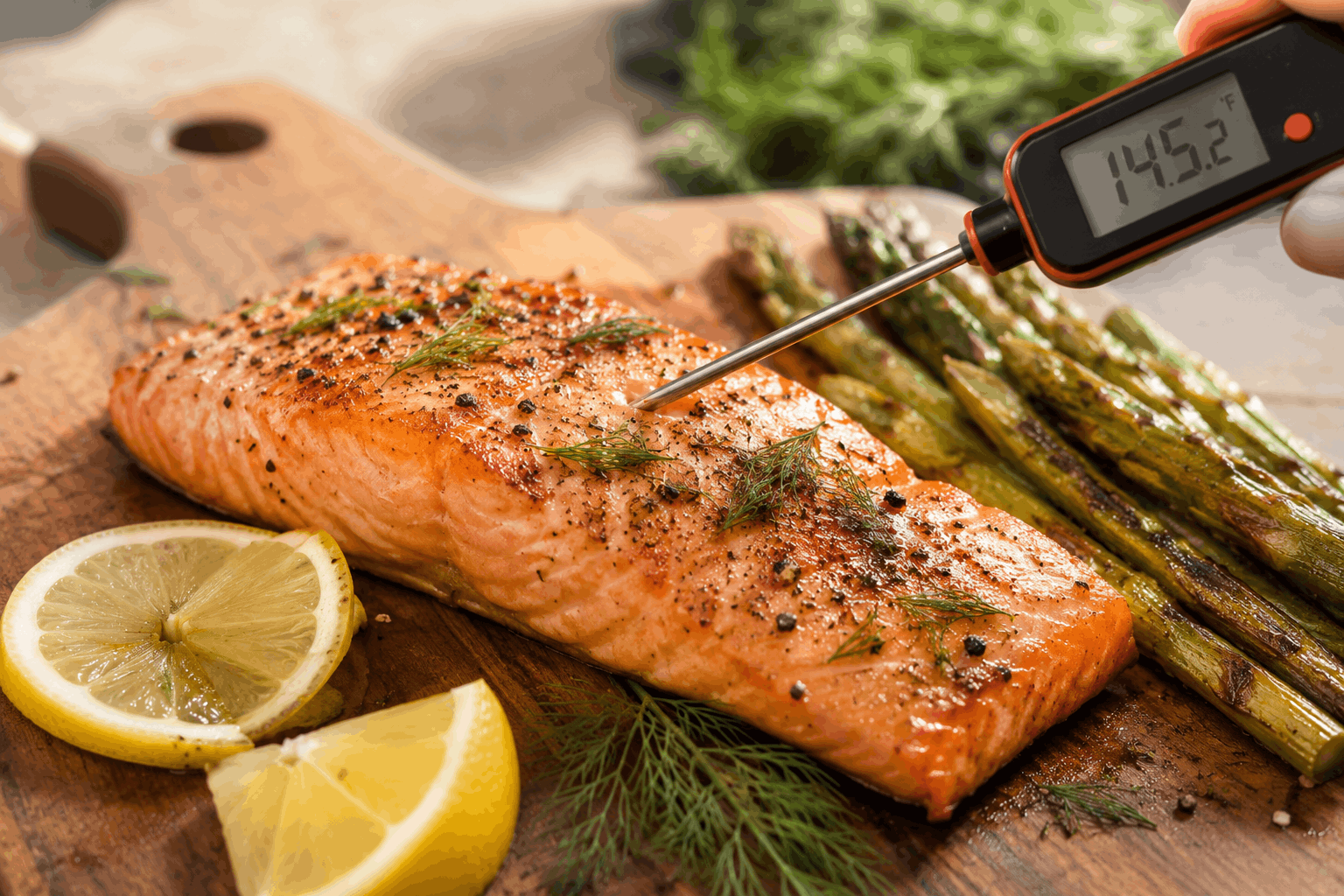
The FDA’s official safe internal temperature for salmon is 145°F. Many chefs pull it earlier, around 120°F to 135°F, for a more tender, moist texture. Both temperatures are widely used, but they serve different purposes. The FDA recommendation prioritizes food safety, while lower chef-preferred temperatures prioritize texture.
This guide covers the official safe temperature, the doneness range chefs actually use, cooking temperatures and times by method, and how to tell when salmon is done without guessing.
Who this guide is for: home cooks unsure whether their salmon is safe to eat; anyone wanting a moister, restaurant-style texture; and cooks comparing salmon against other fish like halibut or cod.
Last verified: July 2026.
Quick Answer: What Temperature Is Salmon Done?
The FDA recommends cooking salmon to an internal temperature of 145°F to eliminate harmful bacteria. For a moister, more tender texture, many chefs prefer pulling salmon at 120°F to 135°F, though this range carries more risk and depends on using high-quality, fresh salmon from a reputable source.
How We Verified This Information
Temperature recommendations here are drawn from FDA food safety guidance and cross-referenced against professional chef and seafood-industry sources for the texture-preference range. Where sources disagreed on exact degree ranges, we used the middle of the commonly cited range rather than the most extreme number from any single source.
Salmon Temperature Chart by Doneness
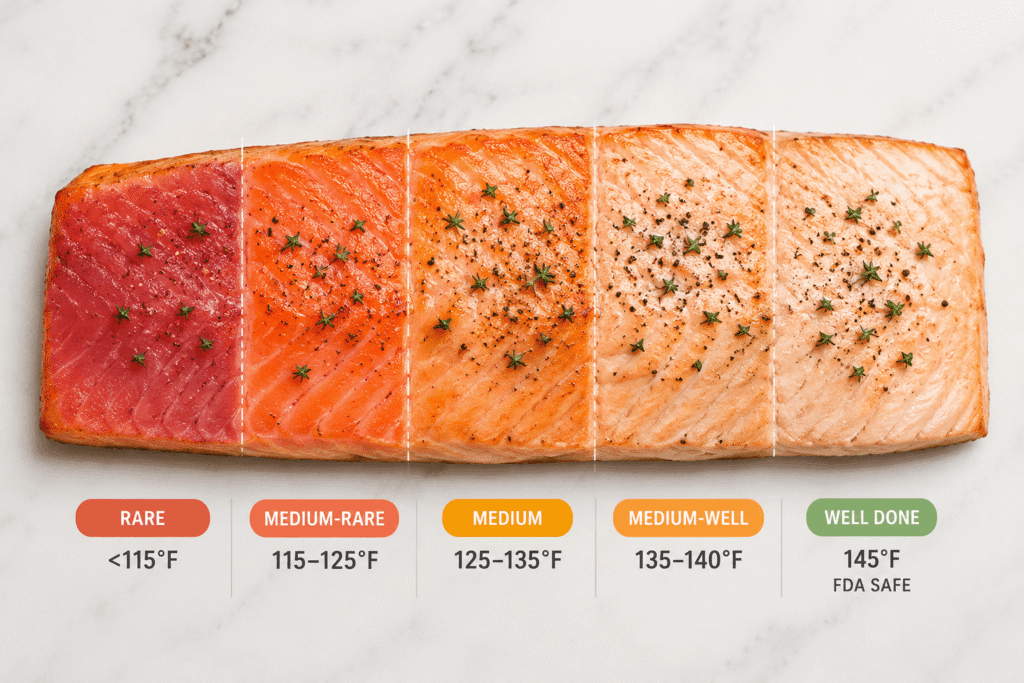
| Doneness | Internal Temperature | Appearance |
| Rare | Below 115°F | Translucent, very soft, not generally recommended |
| Medium-rare | 115°F to 125°F | Mostly opaque, soft, just beginning to firm up |
| Medium | 125°F to 135°F | Soft flakes, tender, slightly firm |
| Medium-well | 135°F to 140°F | Firm flakes, only a hint of translucency at the center |
| Well-done (FDA-safe minimum) | 145°F | Fully opaque, flakes easily, firmest texture |
These ranges reflect commonly cited chef preferences for texture. The FDA’s official safe minimum is 145°F, and cooking below that temperature carries additional food safety considerations covered below.
FDA Safe Temperature vs. Chef-Preferred Temperature
The FDA and USDA recommend cooking salmon to an internal temperature of 145°F, checking that the flesh is opaque and flakes easily. This is the number to follow if food safety is your top priority, especially for anyone serving salmon to others without knowing their risk tolerance.
Many professional chefs pull salmon earlier, often 120°F to 135°F, because salmon has very little connective tissue and dries out quickly past that range. At these lower temperatures, the fish stays moist and tender, but this approach depends on starting with high-quality, fresh salmon from a reputable source, since lower temperatures don’t guarantee all bacteria are eliminated.
Who should stick to 145°F: pregnant individuals, young children, older adults, and anyone with a compromised immune system, since these groups face higher risk from foodborne illness even from high-quality fish.
Target Temperature by Preference
| If You Want… | Pull Salmon At |
| Maximum food safety | 145°F |
| Moist, medium salmon | 125°F to 130°F |
| Firmer but still juicy salmon | 130°F to 135°F |
Can You Eat Medium-Rare Salmon?
Yes, if the salmon is fresh, high-quality, and from a reputable source. Medium-rare salmon, generally 115°F to 125°F, is a common choice among chefs for its texture, but it carries more food safety risk than the FDA’s 145°F recommendation and isn’t advised for higher-risk groups.
Carryover Cooking: Why Salmon Keeps Cooking After You Remove It
Salmon continues cooking for a few minutes after you take it off the heat, as residual heat moves from the outer layers toward the center. Pulling a fillet off a hot grill at 120°F, for example, can leave it closer to 130°F by the time it finishes resting. Thicker fillets tend to carry over more than thin ones, so if you’re aiming for a specific final temperature, pull the salmon a few degrees before you hit your target.
Resting time: let salmon rest for 3 to 5 minutes before serving. This allows carryover cooking to finish and lets juices redistribute evenly through the fillet.
Chef Tip: If you’re aiming for a final internal temperature of 130°F, remove the salmon from the heat around 125°F and let carryover cooking finish the job.
How to Check Salmon’s Internal Temperature
Insert an instant-read thermometer horizontally into the thickest part of the fillet from the side, stopping near the center without touching the pan or skin. Wait a few seconds for the reading to stabilize before removing it. Checking the internal temperature for salmon with a digital thermometer is the easiest way to avoid overcooking. Instant-read digital thermometers are generally more accurate than oven-safe dial thermometers for fish, since salmon cooks quickly and a dial thermometer’s slower response time can miss the correct moment. Visual cues like color and flakiness are helpful secondary signals, but they’re less reliable than a thermometer reading, since fat content and thickness vary between fillets and can make a still-underdone piece look done.
Cooking Temperatures and Times by Method
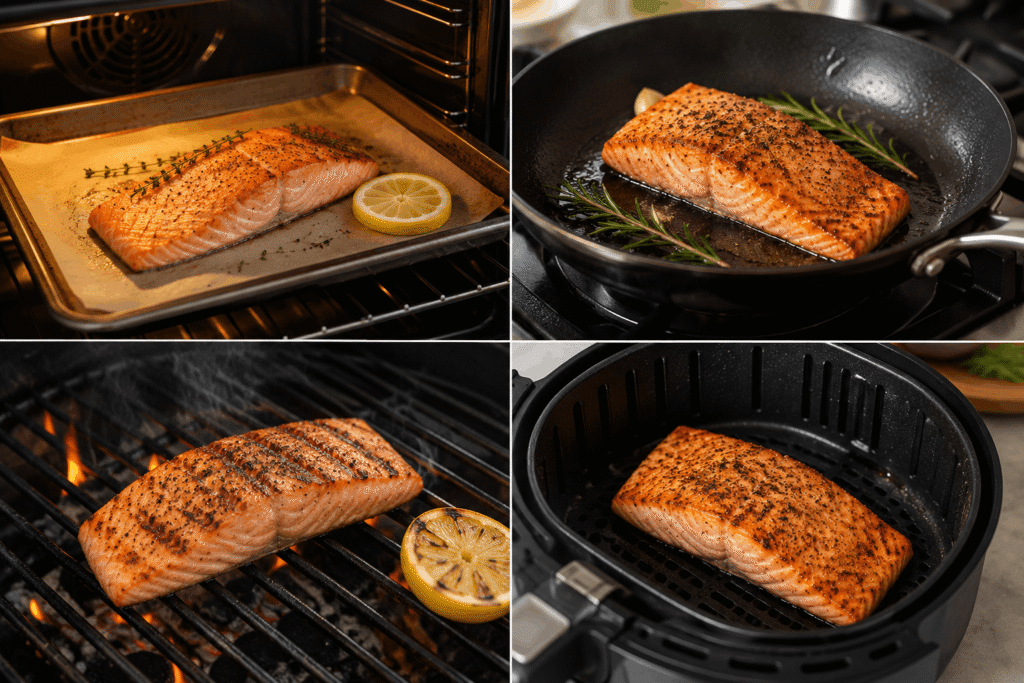
| Method | Temperature | Approximate Time |
| Baking | 400°F | 12 to 15 minutes per inch of thickness |
| Air frying | 390°F to 400°F | 7 to 10 minutes depending on thickness |
| Grilling | Medium heat (375°F to 450°F) | 4 to 6 minutes per side |
| Pan-searing | Medium-high heat | 6 to 8 minutes skin-side down, 1 to 2 minutes on the flesh side |
| Broiling | High | 6 to 8 minutes total, watched closely |
Times are general estimates that vary by fillet thickness and equipment, so always confirm doneness with a thermometer rather than relying on time alone.
Baking Temperature Variations
| Oven Temp | Approximate Time |
| 375°F | 15 to 18 minutes |
| 400°F | 12 to 15 minutes |
| 425°F | 10 to 12 minutes |
While 400°F is a reliable all-purpose baking temperature, salmon can also be baked at 375°F or 425°F, adjusting the time as shown above.
Air Fryer Salmon
Cook at 390°F to 400°F for about 7 to 10 minutes, depending on thickness. As with any method, pull the salmon at your preferred internal temperature rather than relying only on the time, since air fryer models vary in actual cooking power.
Cooking Time by Fillet Thickness
| Thickness | Approximate Baking Time (400°F) |
| 1/2 inch | 8 to 10 minutes |
| 1 inch | 12 to 15 minutes |
| 1 1/2 inches | 16 to 20 minutes |
Thickness matters more than weight alone, so measure the fillet at its thickest point rather than estimating from the package size.
Skin-On vs. Skinless Salmon
Skin-on salmon insulates the flesh slightly and helps prevent overcooking, especially with high-heat methods like pan-searing or grilling. Many cooks leave the skin on through cooking, even if they don’t plan to eat it, since it helps the fillet hold together and release more easily from the pan. Skin-on fillets are usually best cooked skin-side down for most of the cooking time, then flipped briefly if desired.
Can You Cook Frozen Salmon?
Yes. Frozen salmon can go straight into the oven, air fryer, or pan without thawing first. Add roughly 5 to 10 minutes to your usual cook time, and rely on a thermometer rather than time alone, since frozen fillets cook less predictably than fresh ones.
Wild vs. Farmed Salmon: Does Cook Time Change?
Wild salmon is generally leaner than farmed Atlantic salmon, which means it cooks faster and dries out more easily if overcooked. If you’re used to farmed salmon’s typical cook times, wild salmon may reach your target temperature several minutes sooner, so check it earlier than you would a farmed fillet of the same thickness.
Salmon vs. Cod vs. Halibut: Recommended Cooking Temperatures
| Fish | Recommended Doneness Temperature |
| Salmon | 125°F to 135°F for medium and 145°F for FDA safe minimum |
| Halibut | 130°F to 135°F |
| Cod | 130°F to 135°F |
Halibut and cod are both leaner, firmer fish than salmon, so they generally hold together well at similar temperatures without the same risk of drying out quite as fast, though all three still benefit from a thermometer rather than guesswork.
Does the Temperature Change for Different Salmon Cuts?
Whether you’re cooking fillets, steaks, or a whole side of salmon, the target internal temperature stays the same. Thicker cuts simply take longer to reach your desired doneness, so always measure the thickest part with an instant-read thermometer.
Salmon Nutrition Basics
Salmon is a strong source of omega-3 fatty acids, vitamin D, vitamin B12, and high-quality protein, which is part of why it remains one of the most recommended fish for regular consumption in general dietary guidance. A typical serving also provides around 20 to 25 grams of protein, making salmon one of the more nutrient-dense seafood choices per serving.
How to Tell When Salmon Is Done Without a Thermometer
If you don’t have a thermometer, gently press the thickest part of the fillet with a fork or your finger.
- The flesh should flake easily.
- The center should be mostly opaque.
- It should still look moist rather than dry or chalky.
These visual cues are useful, but an instant-read thermometer remains the most reliable way to judge doneness.
Common Mistakes When Cooking Salmon
- Relying only on color or flakiness: these cues vary by fillet and lighting, making a thermometer far more reliable.
- Not accounting for carryover cooking: pulling salmon exactly at your target temperature often means it overshoots by several degrees after resting.
- Cooking wild and farmed salmon for the same amount of time: wild salmon’s lower fat content means it usually cooks faster.
- Skipping the resting period: a few minutes of rest let juices redistribute and even out the final texture.
- Assuming all fish share salmon’s temperature guidelines: firmer, leaner fish like halibut and cod have their own recommended ranges.
Frequently Asked Questions
What temperature should salmon be cooked to?
The FDA’s official safe minimum is 145°F. Many chefs prefer pulling salmon at 120°F to 135°F for a moister texture, though this depends on using high-quality, fresh fish from a reputable source.
Is it safe to eat salmon cooked to 125°F?
It can be, if the salmon is fresh and from a reputable source, but it carries more food safety risk than the FDA’s 145°F recommendation and isn’t advised for pregnant individuals, young children, or anyone immunocompromised.
Why does my salmon keep cooking after I take it off the heat?
This is called carryover cooking. Residual heat continues moving from the outer layers toward the center for a few minutes, which can raise the internal temperature by several degrees even after removal from heat.
Does wild salmon cook faster than farmed salmon?
Yes, generally. Wild salmon has less fat than farmed Atlantic salmon, which means it tends to cook faster and can dry out more easily if overcooked.
How do I check salmon’s temperature without a thermometer?
Press the fillet gently. If it flakes easily and the center is no longer translucent, it’s likely done, though a thermometer remains the most reliable way to confirm.
Can you cook salmon from frozen?
Yes, without thawing first, though it typically needs about 5 to 10 minutes longer than a fresh fillet, and checking with a thermometer matters more than following a fixed time.
What temperature should you air fry salmon at?
Around 390°F to 400°F for roughly 7 to 10 minutes, depending on thickness, checking with a thermometer near the end of cooking.
Should salmon be pink in the middle?
Yes. Salmon cooked to chef-preferred temperatures around 125°F to 135°F often remains slightly pink in the center. Salmon cooked to the FDA’s recommended 145°F becomes fully opaque and flakes easily.
Final Recommendation
If food safety is your top priority, or you’re cooking for someone in a higher-risk group, cook salmon to 145°F. If you want a more tender, restaurant-style texture and are working with fresh, high-quality salmon, 125°F to 135°F is a commonly used middle ground. Either way, pull the salmon a few degrees before your target to account for carryover cooking, and let it rest 3 to 5 minutes before serving.
Salmon Temperature Cheat Sheet
| Goal | Temperature |
| FDA safe minimum | 145°F |
| Medium (chef-preferred) | 125°F to 135°F |
| Air fryer | 390°F to 400°F |
| Baking | 400°F |
| Rest time after cooking | 3 to 5 minutes |
Always measure the temperature at the thickest part of the fillet with an instant-read thermometer for the most accurate result.
Conclusion
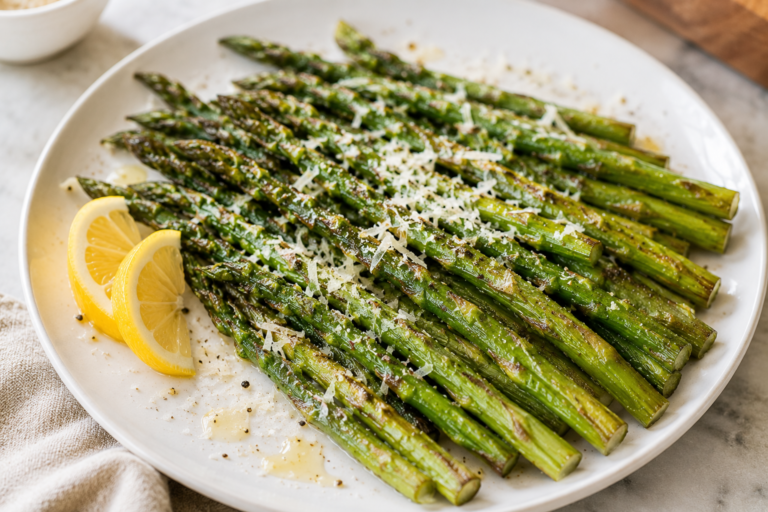
Salmon cook temp comes down to balancing food safety against texture preference, and both are valid depending on your situation. Use a thermometer rather than guessing by color, account for carryover cooking, and adjust your expectations slightly for wild versus farmed salmon or a different cooking method like the air fryer. Pair salmon with vegetables that cook in a similar amount of time so everything is ready to serve together. Our guide to cooking asparagus covers several methods that finish around the same time as a pan-seared or roasted salmon fillet.
Sources
- U.S. Food and Drug Administration (FDA), food safety guidance for seafood
- U.S. Department of Agriculture (USDA), safe minimum internal temperature guidance
- Professional chef and seafood industry sources, for commonly cited texture-preference ranges