What Is the Marketing Concept?

Search “the marketing concept”, and most results quietly answer a different question: what are the five marketing concepts? That’s a related but genuinely separate topic. The marketing concept, specifically, is one particular business philosophy, a customer-first orientation, not the umbrella term covering all five approaches companies have used throughout history. The philosophy became a central principle of modern marketing management during the mid-20th century and has since been widely developed in marketing literature by scholars such as Philip Kotler.
This guide defines the marketing concept precisely, distinguishes it from the other four philosophies it’s often lumped in with, and shows how it plays out in a real business decision.
Who this guide is for: marketing and business students needing a precise definition, professionals comparing their company’s orientation against competitors, and anyone confused by content that blends this term with the broader five-concepts framework.
Last verified: July 2026.
Quick Answer
The marketing concept is a business philosophy holding that a company achieves its goals by understanding customer needs and delivering value more effectively than competitors, rather than by focusing primarily on production efficiency, product quality, or aggressive selling. It’s one of five historical marketing orientations, not a synonym for all of them.
Marketing Concept vs. Five Marketing Concepts
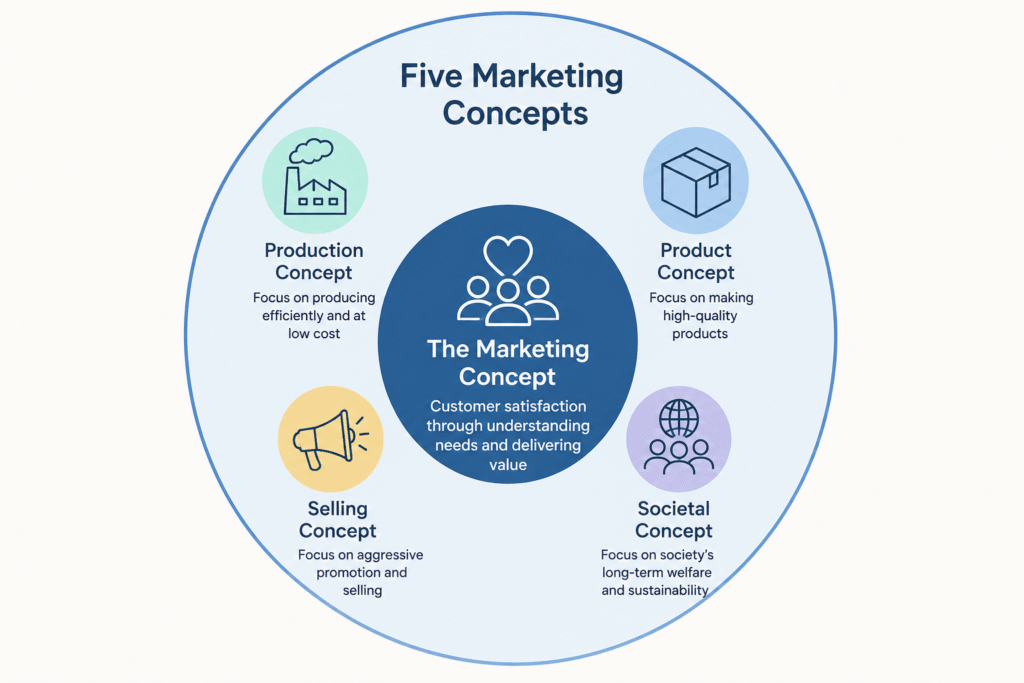
This is the single most common point of confusion, and it’s worth resolving before anything else.
“The marketing concept” refers specifically to the customer-centric philosophy: understand what customers need, then build products and messaging around that need, rather than starting from what the company already makes or wants to sell.
“The five marketing concepts” (or five marketing management orientations) is the broader historical framework that includes the marketing concept as just one of five stages: production, product, selling, marketing, and societal. When a source title asks, “What is the marketing concept?” but then walks through all five, it’s actually answering a related but different question.
The Four Pillars of the Marketing Concept
| Pillar | What It Means |
| Target market | Defining a specific customer group rather than trying to serve everyone |
| Customer needs | Starting product and messaging decisions from what that group actually needs |
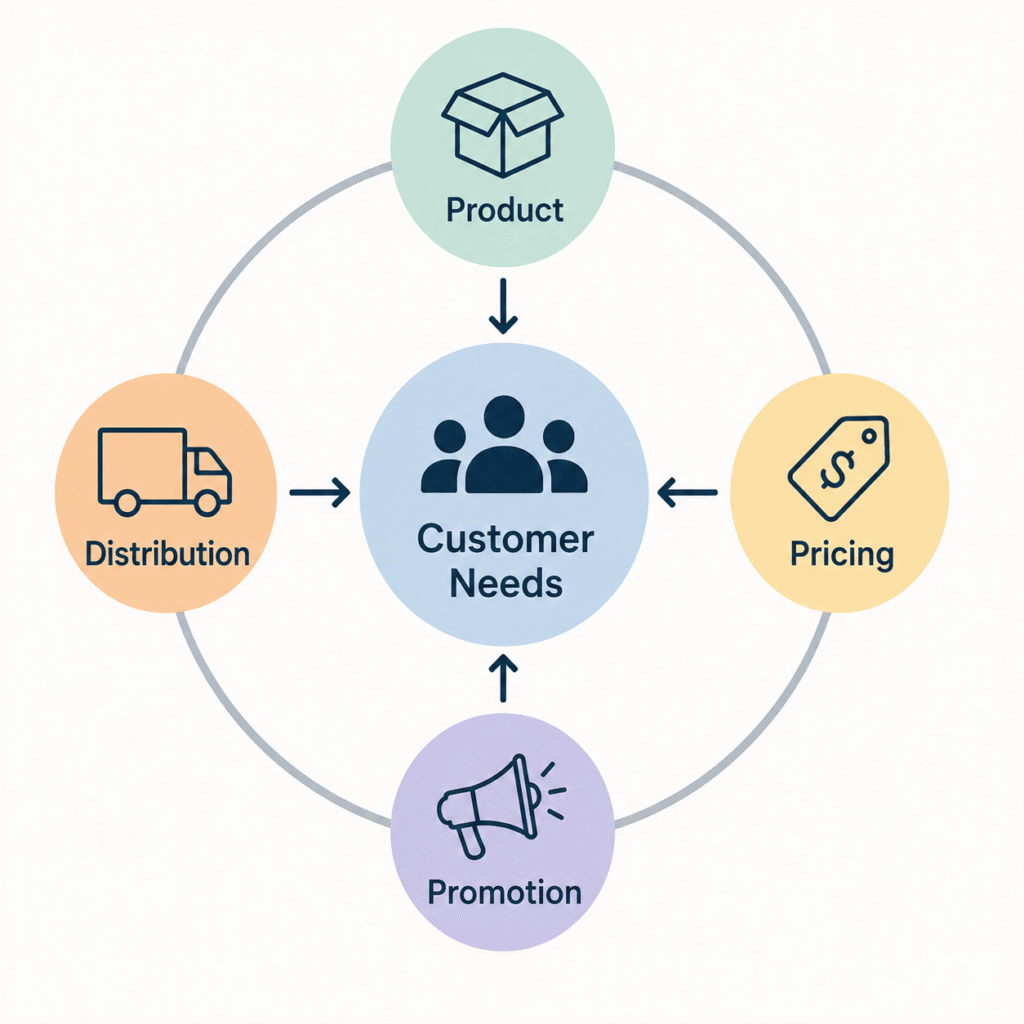
| Integrated marketing | Aligning product, pricing, distribution, and promotion around the same customer-first goal |
| Profitability | Achieving business goals through customer satisfaction, not instead of profitability |
Integrated marketing means ensuring that product design, pricing, distribution, customer service, and promotion all support the same customer-focused strategy. If these functions work independently of each other, the customer experience often becomes inconsistent, undermining the customer-first approach the marketing concept is built around.
Marketing Concept vs. Sales Concept
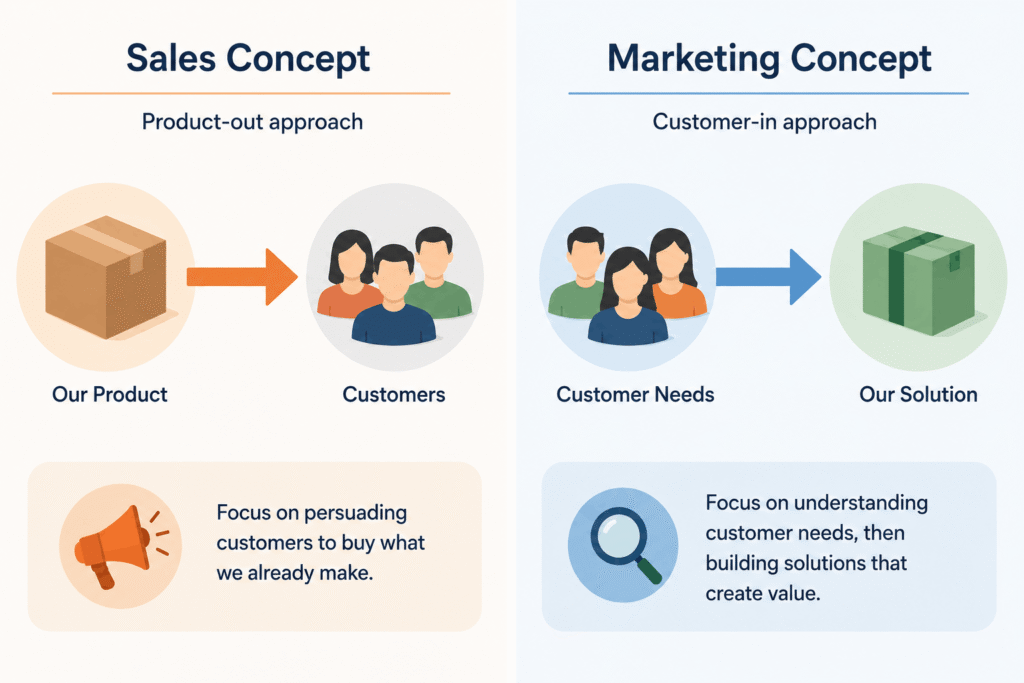
These two are the most frequently confused pair, and the distinction is genuinely useful in practice.
| Marketing Concept | Sales Concept | |
| Starting point | Customer needs | The product the company already has |
| Primary focus | Building long-term customer relationships | Converting existing inventory into revenue |
| Typical approach | Research needs, then build and message accordingly | Persuade customers to buy what’s already made |
| Risk if overdone | Can be slow to act without strong execution | Can prioritize short-term sales over customer trust |
A company following the sales concept asks, “How do we sell more of what we’ve already made?” A company following the marketing concept asks, “what does the customer actually need, and how do we build toward that?”
The Five Marketing Orientations, Compared
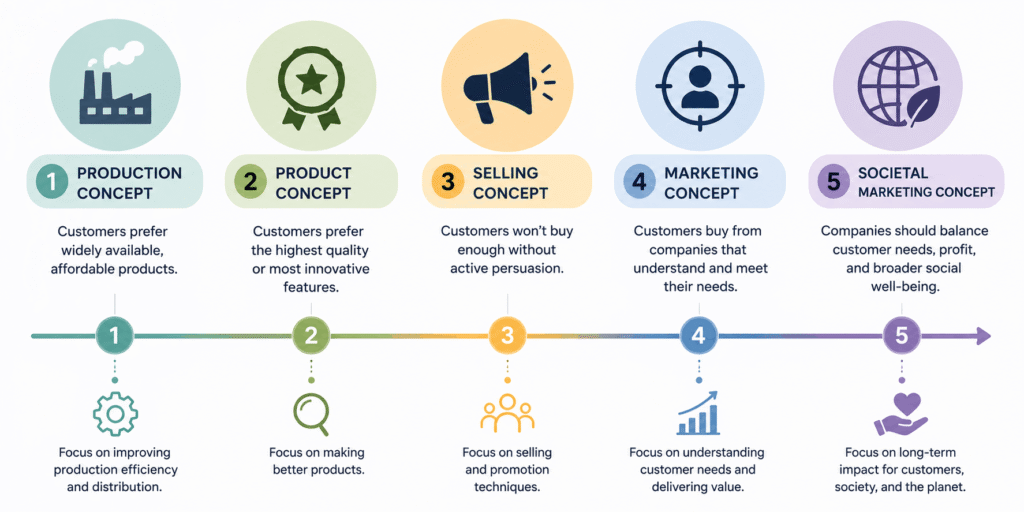
Understanding the marketing concept is clearer once you see it next to the other four philosophies it evolved from and alongside.
| Orientation | Core Assumption | Modern Example Context |
| Production concept | Customers prefer widely available, affordable products | Mass manufacturing focused on cost efficiency |
| Product concept | Customers prefer the highest quality or most innovative features | Companies that over-invest in features customers didn’t ask for |
| Selling concept | Customers won’t buy enough without active persuasion | High-pressure sales environments, aggressive promotion |
| Marketing concept | Customers buy from companies that understand and meet their needs | Research-driven product development and messaging |
| Societal marketing concept | Companies should balance customer needs, profit, and broader social well-being. | Brands incorporating sustainability or ethical sourcing into strategy |
Who should study all five, not just the marketing concept alone: business and marketing students, since exam and interview questions often test the ability to distinguish between all five orientations, not just define one.
A Real-World Example

Consider two companies both selling running shoes. One follows the selling concept: it manufactures a standard shoe, then invests heavily in advertising and in-store promotions to move inventory, regardless of what runners are specifically asking for. The other follows the marketing concept: it surveys runners, discovers a common complaint about ankle support in a specific terrain type, and designs a new shoe specifically addressing that need before scaling up marketing around it. Both companies might advertise heavily, but only the second one let customer needs drive the product itself, which is the defining difference between the two orientations.
Common Misconceptions About the Marketing Concept
- “The marketing concept just means having a marketing department.” Having a marketing team doesn’t automatically mean a company follows this philosophy. A company can have an active marketing department while still operating on a sales or product-first orientation internally.
- “The marketing concept and the five marketing concepts are the same thing.” The marketing concept is one specific philosophy within the broader five-part framework, not an umbrella term for all of them.
- “Only large companies need to think about their marketing orientation.” Small businesses adopt these orientations too, often without naming them explicitly, and the same distinctions apply regardless of company size.
Frequently Asked Questions
What is the simplest definition of the marketing concept?
The marketing concept is a business philosophy that prioritizes understanding and meeting customer needs as the primary way to achieve company goals, rather than focusing mainly on production, product features, or aggressive selling.
What are the five marketing concepts?
The five marketing concepts, or orientations, are the production concept, the product concept, the selling concept, the marketing concept, and the societal marketing concept, each representing a different historical approach to business strategy.
What is the difference between the marketing concept and the sales concept?
The sales concept starts with the product a company already has and focuses on persuading customers to buy it. The marketing concept starts with customer needs and builds the product and strategy around meeting them.
Why is the marketing concept considered customer-centric?
Because every major business decision, including product design, pricing, promotion, and distribution, is meant to start with an understanding of customer needs rather than what the company wants to produce or sell.
Is the societal marketing concept different from the marketing concept?
Yes. The societal marketing concept builds on the marketing concept but adds a requirement to also consider broader social and environmental well-being, not just individual customer satisfaction and company profit.
Final Recommendation
If you’re studying for an exam or interview, learn all five orientations together rather than just the marketing concept in isolation, since questions often test the ability to distinguish between them. If you’re evaluating your own company’s approach, compare your actual product development process against the marketing concept’s customer-first starting point, not just whether you have a marketing team.
Conclusion
The marketing concept is a specific, customer-first business philosophy, distinct from the broader five-concept framework it often gets confused with. Understanding where your own company’s decisions actually start, from customer need, from the product itself, or from a sales target, reveals more about your real orientation than which term you use to describe it. If you’re building the broader business acumen to evaluate strategic decisions like this, understanding business development as a related but distinct function is a natural next step.
Sources
- American Marketing Association (AMA), marketing definitions and terminology
- Academic marketing management textbooks and course materials on marketing orientations