
Best Travel Credit Card in 2026

The right travel credit card can turn everyday spending into free flights, hotel stays, and airport lounge access. The wrong one can leave you paying a high annual fee for perks you never actually use.
This guide compares the best travel credit card options by what actually matters: rewards structure, annual fees, foreign transaction fees, transfer partners, and lounge access so you can match a card to how you actually travel instead of chasing the flashiest sign-up bonus.
Who this guide is for: frequent travellers, occasional vacationers, business travellers, beginners choosing their first travel card, and anyone deciding between a travel card and a cash-back card. Throughout this guide, you’ll find recommendations for beginners, premium travellers, international travellers, business owners, and people looking for a no-annual-fee travel credit card.
Last verified: July 2026. Credit card terms, fees, rewards rates, and welcome bonuses change often, so confirm current details directly with the issuer before applying.
This article is for general informational purposes and is not financial advice. This ranking isn’t influenced by affiliate partnerships or issuer sponsorships; the order is based on value, fees, flexibility, travel protections, and overall usefulness. Consider your own spending habits, credit profile, and financial situation, and consult a financial advisor if you need personalized guidance.
Common Downsides of Travel Cards
Travel cards aren’t automatically a good deal, and it’s worth knowing the tradeoffs before applying.
- Annual fees: premium cards can cost hundreds of dollars a year, and that fee applies whether or not you travel that year.
- Complex redemption: getting the best value often means learning transfer partners and award charts, not just redeeming for a flat statement credit.
- Interest outweighing rewards: carrying a balance at 20%+ APR erases the value of nearly any rewards program almost immediately.
- Limited lounge access: even premium cards’ lounge networks don’t cover every airport, so access isn’t as universal as it might seem from the marketing.
Methodology: How We Compared These Cards
We compared each card across the same set of factors: annual fee, foreign transaction fee, insurance and travel protections, transfer partners, earning rates on common categories, included credits, and airport lounge access where applicable. Welcome bonuses change too frequently to list as fixed figures here, so we note when a card typically offers a strong one without quoting an exact number that may already be outdated by the time you read this.
Quick Comparison: Best Travel Credit Cards by Category
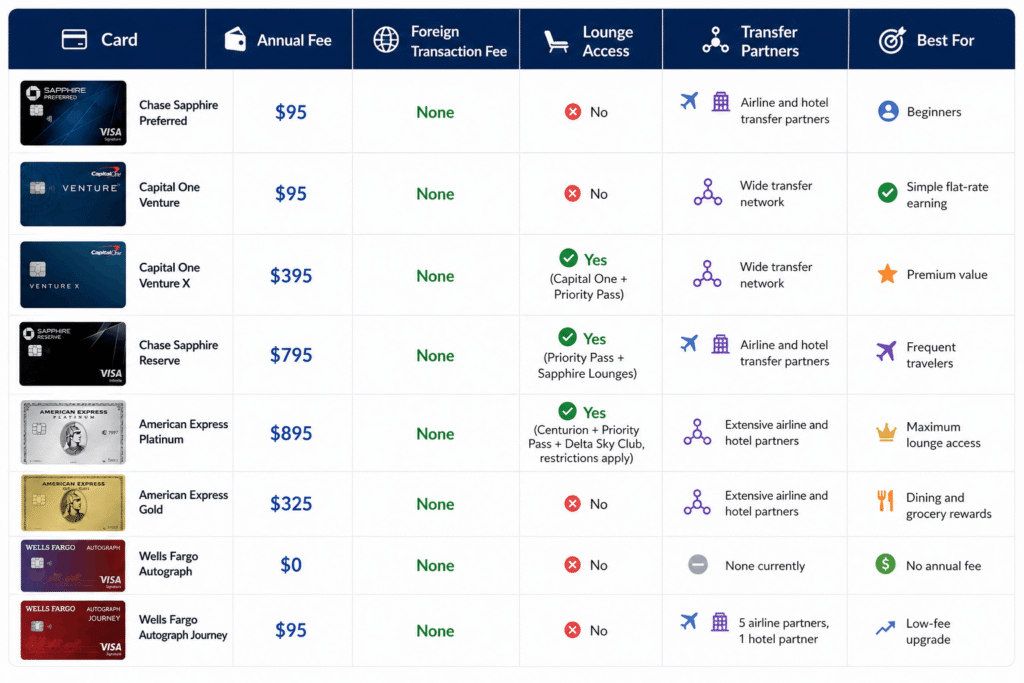
| Card | Annual Fee | Foreign Transaction Fee | Lounge Access | Transfer Partners | Best For |
| Chase Sapphire Preferred | $95 | None | No | Airline and hotel transfer partners | Beginners |
| Capital One Venture | $95 | None | No | Wide transfer network | Simple flat-rate earning |
| Capital One Venture X | $395 | None | Yes (Capital One + Priority Pass) | Wide transfer network | Premium value |
| Chase Sapphire Reserve | $795 | None | Yes (Priority Pass + Sapphire Lounges) | Airline and hotel transfer partners | Frequent travelers |
| American Express Platinum | $895 | None | Yes (Centurion, Priority Pass, and Delta Sky Club; restrictions apply) | Extensive airline and hotel partners | Maximum lounge access |
| American Express Gold | $325 | None | No | Extensive airline and hotel partners | Dining and grocery rewards |
| Wells Fargo Autograph | $0 | None | No | None currently | No annual fee |
| Wells Fargo Autograph Journey | $95 | None | No | 5 airline partners, 1 hotel partner | Low-fee upgrade |
Fees, lounge terms, and partner lists are current as of the last-verified date above based on issuer information at the time of writing, but card terms change without notice. Confirm the exact current annual fee on the issuer’s official page before applying, since even accurate figures at publication can become outdated.
Best Travel Credit Card by Category

- Best overall for beginners: Chase Sapphire Preferred
- Best premium value: Capital One Venture X
- Best with no annual fee: Wells Fargo Autograph
- Best for lounge access: American Express Platinum
- Best for business travelers: American Express Business Platinum
What Credit Score Do You Need for a Travel Credit Card?
Most travel credit cards require good to excellent credit, generally considered a FICO score of 700 or higher, though approval also depends on income, existing debt, and your overall credit history, not the score alone.
- Excellent (740+): typically the safest range for approval on premium cards like the Amex Platinum or Chase Sapphire Reserve.
- Good (670 to 739): usually sufficient for mid-tier cards like the Chase Sapphire Preferred or Capital One Venture.
- Fair (below 670): approval odds drop significantly for most travel cards, and a cash-back or credit-building card is often a more realistic starting point.
Even a strong score doesn’t guarantee approval, since issuers also weigh income and how many new accounts you’ve opened recently.
Are Travel Credit Cards Worth It? (And Who Should Skip Them Entirely)
Travel cards are worth it if you travel often enough to use the perks and, most importantly, pay your balance in full every month. Interest charges on a carried balance almost always outweigh any rewards earned.
Skip a travel card entirely if:
- You regularly carry a balance and pay interest, since a lower-rate card would save you more than any rewards program.
- You travel rarely, since annual fees on premium cards are hard to offset without frequent use.
- You’d rather have straightforward cash back than manage points, transfer partners, and redemption values.
If you expect to carry a balance, compare APRs as carefully as rewards, since interest charges can quickly outweigh any travel benefits.
Travel Card vs. Cash-Back Card: Which Is Better?

Travel cards tend to offer higher value per point when redeemed for flights or hotels, especially through transfer partners, but that value depends on booking flexibility and some effort to learn the redemption system. Cash-back cards offer simpler, guaranteed value with no need to understand transfer ratios or award charts. Popular no-fee cashback options include the Citi Double Cash, Chase Freedom Unlimited, and Capital One Savour. If you travel a few times a year and don’t want to think about points strategy, a straightforward cash-back card can end up being the better financial choice, even if it feels less exciting.
How to Choose: A Simple Decision Guide

- Do you travel internationally more than once a year? If yes, prioritise a card with no foreign transaction fee, which nearly every card on this list already offers.
- Do you want airport lounge access? If yes, compare the Capital One Venture X against the Chase Sapphire Reserve or Amex Platinum based on which lounge network matches airports you actually fly through.
- Can you realistically use enough of a premium card’s credits to offset a $395 to $895 annual fee? If not, a lower-fee card like the Chase Sapphire Preferred or Capital One Venture is usually the smarter choice.
- Do you run a business with regular travel spending? If yes, a business travel card may offer better categories and a separate credit line from your personal cards.
Understanding Credit Card Points Ecosystems
Card issuers each run their own rewards currency, and understanding this matters more than comparing raw point values.
- Chase Ultimate Rewards: points from Chase cards like the Sapphire Preferred and Reserve, transferable to airline and hotel partners including United and Hyatt.
- Capital One Miles: a flexible currency usable as a statement credit for travel purchases or transferable to airline and hotel partners.
- American Express Membership Rewards: points from Amex cards like the Platinum and Gold, with one of the largest transfer partner networks in the industry.
- Citi ThankYou Points: points from Citi’s travel cards, transferable to a smaller but still useful set of airline partners.
Transferring points to an airline or hotel partner usually offers higher value per point than redeeming for a flat statement credit, though it requires more research into award availability.
Best Travel Rewards Credit Cards
These cards focus on flexible points or miles that can be redeemed across multiple airlines and hotels, rather than being locked to one loyalty program.
Chase Sapphire Preferred
Best for: first-time travel cardholders who want strong value without a high annual fee.
Annual fee: $95. Foreign transaction fee: none.
Rewards structure: points on travel booked through Chase’s portal, plus bonus categories on dining, streaming, and grocery purchases, with the ability to transfer points to airline and hotel partners.
Pros: low annual fee, strong transfer partner network, and solid travel protections, including trip cancellation coverage.
Cons: no airport lounge access, and its transfer partner list is smaller than some premium competitors.
Who should skip this: frequent flyers who travel often enough to justify a higher-fee card with airport lounge access, since the Preferred doesn’t include that perk.
Alternative to consider: if you decide you want lounge access later, its premium sibling, the Chase Sapphire Reserve, is the natural upgrade path. If you’d rather avoid an annual fee, the Capital One VentureOne Rewards card is a genuinely no-fee alternative, though with fewer perks.
Practical tip: points often provide more value when redeemed for eligible travel through Chase Travel℠ or through transfer partners than as a flat cash-back redemption, so it’s worth comparing both options before redeeming.
Capital One Venture X
Best for: travellers who want premium perks without paying the highest-tier annual fees.
Annual fee: $395. Foreign transaction fee: none.
Rewards structure: a flat 2 miles per dollar on every purchase, with higher rates on travel booked directly through Capital One, plus an annual travel credit and bonus miles on your account anniversary that can offset much of the fee.
Pros: lounge access at a lower fee than most premium competitors and a simple flat earning rate with no rotating categories to track.
Cons: Its own lounge network is smaller than the Amex Platinum’s, and the flat earning rate means less value for travellers who spend heavily in bonus categories like dining.
Who should skip this: infrequent travellers who won’t use the annual travel credit or lounge access enough to offset the fee.
Alternative to consider: the Capital One Venture card (annual fee applies) offers simple flat-rate earning at a much lower cost if you don’t need lounge access, or the no-fee Venture One if you’d rather skip an annual fee entirely.
Practical tip: The annual travel credit and anniversary bonus miles can offset much of the annual fee for travellers who use them fully, so calculate whether you’ll actually use both before assuming the card is worth it for you.
Best Travel Credit Card with No Annual Fee
Not every traveller wants to pay an annual fee, and solid options exist without one.
Wells Fargo Autograph
Best for: travellers who want solid everyday rewards categories without any ongoing cost.
Annual fee: $0. Foreign transaction fee: none.
Rewards structure: bonus points on everyday categories including restaurants, travel, gas, transit, popular streaming services, and phone plans, with a flat rate on everything else.
Pros: genuinely no annual fee, useful bonus categories that cover common household spending, no foreign transaction fee.
Cons: no transfer partners as of this writing, and no airport lounge access or large annual travel credit. Wells Fargo has been actively expanding its rewards program, so confirm current transfer partner availability before assuming this remains the case.
Who should skip this: travellers who want to transfer points to airline or hotel partners, since this card doesn’t currently offer that option.
Alternative to consider: its low-fee upgrade, the Wells Fargo Autograph Journey, adds transfer partners and travel insurance for a $95 annual fee and often makes sense if you travel enough to use those extras. Other no-fee alternatives worth comparing include the Capital One VentureOne, Bank of America Travel Rewards, and Discover it Miles.
Practical tip: because it carries no annual fee, this can make sense as a secondary card even if you also carry a premium travel card, since there’s no ongoing cost to holding it.
Best Credit Cards for International Travel
International trips come with their own considerations, mainly foreign transaction fees, worldwide acceptance, and travel insurance coverage. Since a credit card is just one part of international trip planning, it’s worth double-checking your travel documents too. Our guide to passport requirements for US travellers is a useful starting point if you’re not sure your documentation is current.
Chase Sapphire Reserve
Best for: frequent international travellers who want strong protections and no foreign transaction fees.
Annual fee: $795. Foreign transaction fee: none.
Rewards structure: points on travel and dining, with a large annual travel credit that applies automatically to a wide range of travel purchases, plus broad airport lounge access.
Pros: large, easy-to-use annual travel credit, strong lounge access, solid travel insurance, including trip delay and baggage coverage.
Cons: one of the highest annual fees on this list, and much of its value depends on actively using the credits and lounge access.
Who should skip this: occasional travellers, since the high annual fee is difficult to justify without frequent use of the card’s travel credits and lounge access.
Alternative to consider: the Wells Fargo Autograph Journey for a much lower annual fee with primary (rather than secondary) rental car insurance abroad.
Practical tip: no foreign transaction fees apply, and the card is widely accepted internationally, which matters more on a multi-country trip than most people expect. If you’re planning international flights, our guide to international airline options covers route and cabin comparisons worth checking alongside your card benefits.
Travel Insurance Comparison

Travel protections vary meaningfully between cards, and this is often overlooked in favour of just comparing points.
| Card | Trip Cancellation | Rental Car Collision Coverage | Lost Baggage |
| Chase Sapphire Preferred | Yes | Primary | Yes |
| Chase Sapphire Reserve | Yes | Primary | Yes |
| Capital One Venture X | Yes | Secondary | Yes |
| Wells Fargo Autograph Journey | Yes | Primary | Yes |
| Wells Fargo Autograph | No | Secondary | No |
This table shows whether a protection exists, not identical coverage. Coverage limits, exclusions, covered reasons, and whether coverage is primary or secondary vary by issuer and should always be reviewed in the official Guide to Benefits for that specific card.
Best Travel Credit Cards with Lounge Access

Lounge access has become a more valuable perk as airports get busier and access restrictions tighten. Not all lounge access is equal, so compare the specific network each card includes.
| Card | Lounge Network |
| American Express Platinum | Centurion Lounges, Priority Pass Select, Delta Sky Club (with restrictions) |
| Chase Sapphire Reserve | Priority Pass Select, Chase Sapphire Lounges |
| Capital One Venture X | Capital One Lounges, Priority Pass Select |
American Express Platinum
Best for: travellers who fly often enough to make frequent use of airport lounges.
Annual fee: $895. Foreign transaction fee: none.
Rewards structure: access to Centurion Lounges plus Priority Pass Select, along with hotel credits and elite status perks, though the base rewards rate on everyday spending is comparatively low.
Pros: the widest lounge network on this list and strong hotel elite status perks through Fine Hotels + Resorts.
Cons: highest annual fee on this list, low base earning rate outside bonus categories.
Who should skip this: travellers who don’t fly often, since the high annual fee is hard to justify without regular lounge use.
Alternative to consider: Capital One Venture X for meaningfully lower-cost lounge access, if the smaller network still covers airports you use.
Practical tip: the card’s value comes largely from its credits and lounge access rather than its base earning rate, so it works best for people who will actively use those specific perks.
Hotel Loyalty Benefits Worth Knowing About
Some premium co-branded hotel cards include automatic elite status, though this varies by specific card, not by hotel brand as a whole.
- Marriott Bonvoy: Certain premium co-branded Marriott cards include automatic Gold Elite status, adding room upgrades and late checkout when available, though not every Marriott card offers this.
- Hilton Honours: some premium co-branded Hilton cards include automatic Gold status, which can include complimentary breakfast at many properties, though entry-level Hilton cards typically don’t include this tier.
- World of Hyatt: Generally requires more spending to reach elite status through a co-branded card, but Hyatt’s program is often considered strong value for the points required.
Check the specific card’s benefits guide rather than assuming a hotel brand’s cards all include the same status tier.
Best Business Travel Credit Cards
Business travellers have different priorities, often including higher spending limits, employee card options, and business-specific bonus categories.
American Express Business Platinum
Best for: business owners who travel frequently and want premium perks similar to the personal Platinum card.
Annual fee: premium tier, comparable to the personal Platinum card. Foreign transaction fee: none.
Rewards structure: bonus points on business-relevant categories like shipping and technology purchases, along with lounge access and travel credits similar to the personal Amex Platinum.
Pros: Premium lounge access extends to a business card, useful bonus categories for common business expenses and employee card options.
Cons: high annual fee similar to the personal Platinum and much of its value depends on consistent business travel to justify it.
Who should skip this: small business owners with lower travel spending, since the annual fee requires meaningful business travel to justify.
Other business travel cards worth comparing: the Capital One Venture X Business offers similar flat-rate earning to the personal Venture X at a business-card level, and the Chase Ink Business Preferred offers strong bonus categories for business owners who prioritize flexible points over lounge access.
Practical tip: business cards often offer separate signup bonuses from personal cards with the same issuer, so it’s worth checking current issuer rules on eligibility before assuming you qualify for both.
Welcome Bonuses
Most premium travel cards periodically offer welcome bonuses, but the exact amount and spending requirement change frequently, sometimes even for the same card. Always compare the current public offer directly on the issuer’s site before applying, rather than relying on a figure from an older article or ad.
Redemption Options Compared
| Card | Flights | Hotels | Transfer Partners | Cash Back | Statement Credit |
| Chase Sapphire Preferred | Yes, via portal or transfer | Yes, via portal or transfer | Yes | Yes | Yes |
| Capital One Venture X | Yes, via portal or transfer | Yes, via portal or transfer | Yes | Yes | Yes |
| American Express Platinum | Yes, via portal or transfer | Yes, via portal or transfer | Yes | Limited | Yes |
| Wells Fargo Autograph | Yes, via the portal. | Yes, via the portal. | No | Yes | Yes |
Redemption values differ significantly by method. Transferring to an airline or hotel partner usually offers more value than a flat statement credit or cash-back redemption, though it takes more research.
Authorized Users
Many premium cards allow you to add authorised users, such as a spouse or family member, sometimes for free and sometimes for an additional fee depending on the card. This can be a practical way to earn rewards faster on shared household spending, though the primary cardholder remains responsible for the account. Business cards often extend a similar option to employee cards, which can also help track business travel spending separately.
Which Networks Do These Cards Use?
Most travel cards on this list run on the Visa or Mastercard network, both of which offer near-universal acceptance internationally. American Express cards are also widely accepted, though slightly less universally than Visa or Mastercard in some countries and at some smaller merchants. If you’re travelling somewhere with less common card acceptance, carrying a backup Visa or Mastercard alongside an Amex card is a reasonable precaution.
Credit cards generally avoid foreign transaction fees on purchases, but this is different from using a card for cash withdrawals abroad. Foreign ATM withdrawals on a credit card are typically treated as a cash advance, which can trigger a separate fee and start accruing interest immediately, even if you pay your statement in full each month.
A Note on Approval Rules
Some issuers apply informal but widely reported approval guidelines that can affect whether you qualify for a new card, regardless of your credit score. These aren’t official published policies, so treat them as general patterns rather than guaranteed rules.
- Chase’s 5/24 rule: Chase generally denies applicants who have opened five or more credit cards (from any issuer) in the past 24 months.
- Amex’s bonus eligibility rules: American Express typically limits how often you can earn a welcome bonus on the same card, sometimes restricting it to once per lifetime per card.
- Capital One’s application frequency limits: Capital One has historically been known for limiting how many new accounts you can open within a short period, though the exact rule isn’t officially published.
These rules change periodically, so research the current version before planning an application strategy around them.
Why Citi Strata Premier Didn’t Make the Top Picks
Citi’s Strata Premier card is a legitimate mid-tier travel card, offering bonus categories and a Citi ThankYou Points transfer network similar in spirit to Chase’s ecosystem. It didn’t make the primary list here mainly because its transfer partner network is smaller than Chase’s or Amex’s, and its perks overlap closely with the Chase Sapphire Preferred at a similar price point. It’s still worth comparing directly against the Sapphire Preferred if you’re deciding between the two, since the better fit often comes down to which specific transfer partners you’d actually use.
Frequently Asked Questions
What is the best travel credit card?
There’s no single best card for everyone. Chase Sapphire Preferred is a strong overall pick for beginners, while Capital One Venture X and Chase Sapphire Reserve suit travellers who want premium perks and can use them often enough to justify the fee.
What is the best travel credit card with no annual fee?
Wells Fargo Autograph is a genuinely no-annual-fee option, offering solid everyday bonus categories. Its paid upgrade, the Autograph Journey, adds transfer partners and travel insurance for a $95 annual fee.
What credit card is best for international travel?
Cards with no foreign transaction fees, like the Chase Sapphire Reserve or Wells Fargo Autograph Journey, tend to work best for international trips, since foreign transaction fees can add up quickly on international purchases.
Do travel credit cards make sense if I only travel once a year?
Not always. If you travel infrequently, a card with a lower or no annual fee often makes more financial sense than a premium card whose perks you won’t use enough to offset a high annual fee.
What credit score do I need for a travel credit card?
Most travel credit cards require good to excellent credit, generally a FICO score of 700 or higher, though exact requirements vary by issuer and aren’t guaranteed even with a strong score.
Is a travel credit card better than a cash-back card?
It depends on your travel frequency and willingness to manage points. Travel cards can offer higher value per point through transfer partners, but cash-back cards offer simpler, guaranteed value with less effort.
Is airport lounge access worth paying for?
It depends on how often you fly. If you fly several times a year and value a quieter space, free snacks, and Wi-Fi before a flight, lounge access can justify a higher annual fee. If you fly only occasionally, the cost is harder to offset compared to a lower-fee card.
Quick Answer: If You Are… Which Card to Pick
| If you are… | Consider |
| A beginner choosing your first travel card | Chase Sapphire Preferred |
| A luxury traveler wanting maximum lounge access | American Express Platinum |
| Someone who wants lounge access at a lower cost | Capital One Venture X |
| Avoiding annual fees entirely | Wells Fargo Autograph |
| A frequent international traveler | Chase Sapphire Reserve or Wells Fargo Autograph Journey |
| A business owner with regular travel spending | American Express Business Platinum |
Final Recommendation

If this is your first travel card, Chase Sapphire Preferred offers strong value at a manageable annual fee. If you travel often enough to use lounge access and a larger annual travel credit, Capital One Venture X offers premium perks at a lower fee than the top-tier cards. If you’d rather avoid an annual fee altogether, Wells Fargo Autograph is a genuinely free starting point.
Conclusion
The best travel credit card depends on how often you travel, what perks you’ll actually use, and whether you can pay your balance in full each month to avoid interest charges that would outweigh any rewards earned. Compare the annual fee against the specific perks you’d realistically use before applying, and check the issuer’s official page for current terms, since rates and benefits change over time.
Sources
- Consumer Financial Protection Bureau, credit card terms and consumer guidance
- Official issuer pages and Guide to Benefits documents for Chase, Capital One, American Express, Wells Fargo, and Citi travel credit cards
- NerdWallet, The Points Guy, and Bankrate, for cross-checking current rates and benefits
- Individual card terms and conditions, available on each issuer’s official website